Winter tests or a bluff poker game?
At a time when testing sessions are extremely limited outside of Grand Prix weekends, the two winter pre-season testing sessions provide teams the opportunity to showcase their cars or remain in the shadows.

A few years earlier, during a time when spending knew no bounds, most teams had enormous testing resources: a full staff was dedicated to it, as well as a single-seater, and a driver, either a regular team driver or a dedicated test driver. One might recall the role of Pedro de la Rosa, who racked up miles at McLaren, for example.
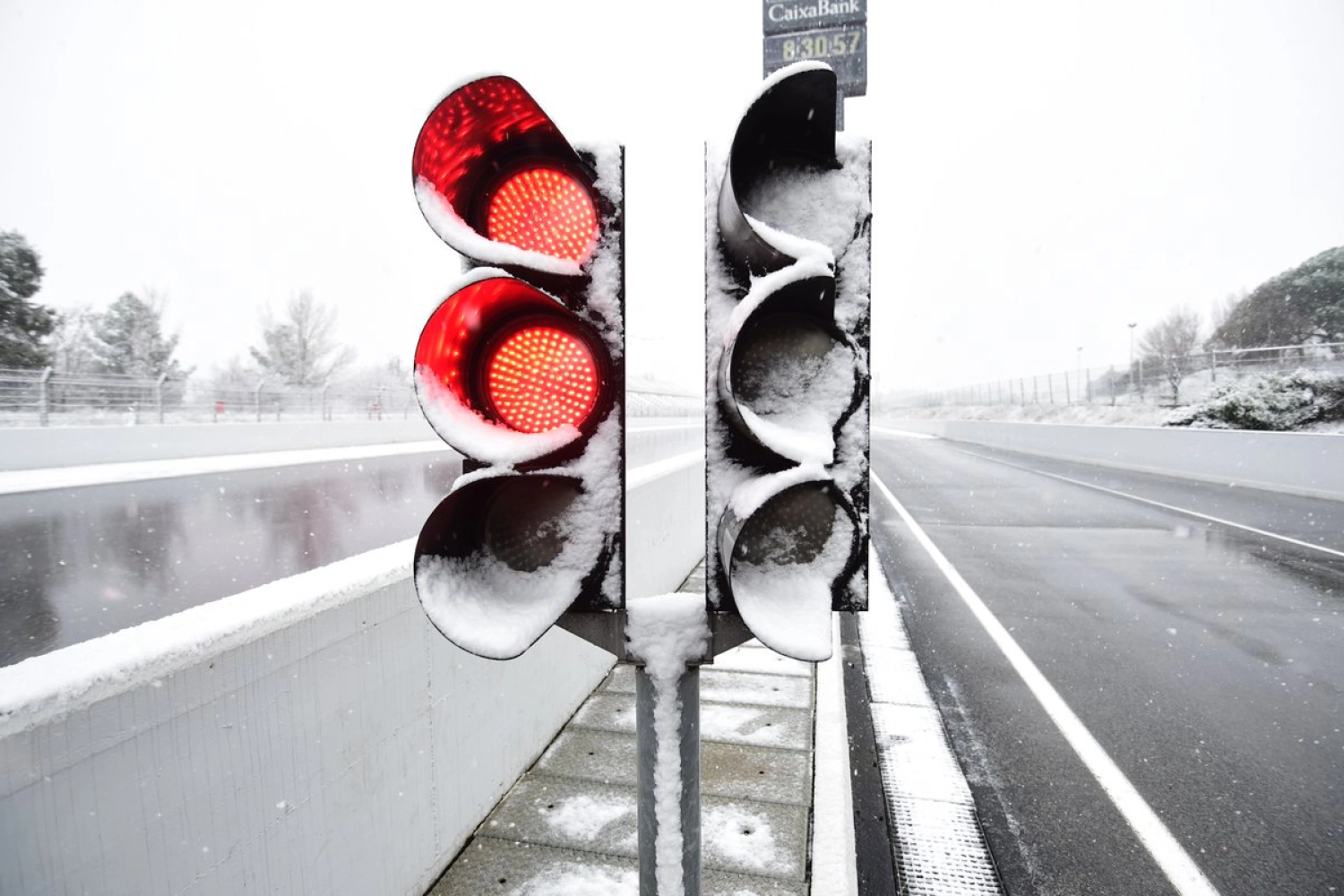
However, the situation has completely changed now, with an extremely reduced number of test days, common to all teams: the now traditional winter testing. This year, there are two sessions of four days each, during which, setting aside the first snowy Wednesday, the single-seaters have accumulated kilometers, best times, or other troubles.
If many observers are quick to draw conclusions and see Ferrari dominating the championship based on promising times at the Barcelona circuit, it is actually extremely difficult to derive any conclusions from merely reading the best times. To have a clear idea of the hierarchy, an observer would need several elements: the fuel load carried during the timed lap, the engine mode used, the exact lap time difference between the different tire compounds, and the driver’s attack percentage.
The only data potentially accessible to outside observers is the difference between the various tires provided by Pirelli, although it is not very precise. Especially in light of the resurfacing of the Catalunya circuit and the cool temperatures observed during these two weeks.
However, if we observe this table:
| DRIVER | TEAM | TIME | TIRES | DAY | |
| 1 | Sebastian Vettel | Ferrari | 1.17.182 | Hyper Soft | 7 |
| 2 | Kimi Räikkönen | Ferrari | 1.17.221 | Hyper Soft | 8 |
| 3 | Fernando Alonso | McLaren-Renault | 1.17.784 | Hyper Soft | 8 |
| 4 | Daniel Ricciardo | Red Bull-Renault | 1.18.047 | Hyper Soft | 6 |
| 5 | Carlos Sainz | Renault | 1.18.092 | Hyper Soft | 8 |
| 6 | Kevin Magnussen | Haas-Ferrari | 1.18.360 | Super Soft | 7 |
| 7 | Pierre Gasly | Toro Rosso-Honda | 1.18.363 | Hyper Soft | 7 |
| 8 | Lewis Hamilton | Mercedes | 1.18.400 | Ultra Soft | 6 |
| 9 | Romain Grosjean | Haas-Ferrari | 1.18.412 | Ultra Soft | 8 |
| 10 | Valtteri Bottas | Mercedes | 1.18.560 | Ultra Soft | 6 |
| 11 | Nico Hülkenberg | Renault | 1.18.675 | Hyper Soft | 7 |
| 12 | Stoffel Vandoorne | McLaren-Mercedes | 1.18.855 | Hyper Soft | 7 |
| 13 | Brendon Hartley | Toro Rosso-Honda | 1.18.949 | Hyper Soft | 8 |
| 14 | Esteban Ocon | Force India-Mercedes | 1.18.967 | Hyper Soft | 8 |
| 15 | Charles Leclerc | Sauber-Ferrari | 1.19.118 | Hyper Soft | 8 |
| 16 | Sergey Sirotkin | Williams-Mercedes | 1.19.189 | Soft | 8 |
| 17 | Marcus Ericsson | Sauber-Ferrari | 1.19.244 | Hyper Soft | 7 |
| 18 | Robert Kubica | Williams-Mercedes | 1.19.629 | Super Soft | 7 |
| 19 | Sergio Pérez | Force India-Mercedes | 1.19.634 | Hyper Soft | 7 |
| 20 | Max Verstappen | Red Bull-Renault | 1.19.842 | Soft | 7 |
| 21 | Lance Stroll | Williams-Mercedes | 1.19.954 | Soft | 8 |
| 22 | Nikita Mazepin | Force India-Mercedes | 1.25.628 | Mediums | 1 |
One can observe that the tire compounds used to set the best lap by each driver can vary: Kevin Magnussen, for instance, managed a 1.18.360 on Super Soft tires, which is the third softest range provided by Pirelli. Meanwhile, Lewis Hamilton’s best time, set at 1.18.400, was on Ultra Soft tires, which are one range higher than the Haas. Does this hint at a decline for Mercedes and total domination by the Gene Haas team? No! It is likely that no team has shown the entirety of its capabilities.
For none of these teams benefited from ideal conditions or found interest in chasing the stopwatch. Moreover, the majority of the times were achieved on Hyper Soft tires, which will not be used during the Spanish Grand Prix nor throughout the entire season, deemed too soft by Pirelli.
But then, what is the actual purpose of winter testing?
Each team has its own schedule to follow, which will vary according to the different points to be respected. We can imagine that Mercedes, which is pushing a concept that worked well in 2017, will not conduct the same tests as McLaren or Toro Rosso, which need to verify the integration of a different engine from last year. The same goes for Williams, who wanted to share their time between Lance Stroll, the new team leader, Sergey Sirotkin, in his first year as a main driver, and Robert Kubica, the reserve but experienced driver.
The primary goal of these winter tests is to accumulate kilometers in order to verify system functionality and detect any small malfunctions that may occur during a Grand Prix weekend: we saw this with McLaren, which noticed the area surrounding its exhaust turning black due to heat, before finding a solution to resolve this issue.
This also allows for verification of the correlation between data collected in wind tunnels or through CFD and the reality of the track. This is achieved by attaching numerous sensor grids to the single-seaters or using Flow Viz, a paint that leaves a trace marking the airflow over the car. This aspect was highlighted last year by Red Bull’s misfortunes, whose wind tunnel results were not confirmed on the track due to a wind tunnel calibration error.
Another goal is to begin establishing a baseline of settings: through the accumulation of kilometers, it is possible to test numerous variations of settings during different stints, something impossible during a Grand Prix weekend, where teams complete only between 40 and 80 laps across the three free practice sessions, with 20 to 30 of those laps reserved for studying tire degradation. The teams were thus able to test their cars’ reactions to changes in settings, allowing them to prepare more confidently for future Grand Prix weekends.
This year, with the arrival of new tire compounds, as well as the modification of existing ones, it was also important to test the different types of rubber, even in conditions that are not very representative of Grand Prix conditions in terms of air and track temperature.
And these winter tests also allow for the first race simulations to be conducted, without any real rules surrounding them. Notably, Mercedes and Red Bull carried out simulations from start to finish on medium tires, which will be prohibited during a Grand Prix weekend, as the race requires teams to use at least two types of tires.
Some teams will also have used the tests to try out an initial wave of improvements, although some of them, like Force India, McLaren, or Red Bull have clearly evolved very little since their car was unveiled to the public. In any case, it is certain that for many teams, Melbourne will see numerous developments added to, or within, their car.
These tests therefore provide teams with a lot of insights about themselves, about the weaknesses or strengths of their cars, about their reliability… but they don’t provide much information, apart from the reliability of the cars, to outside observers.
As many drivers have said, the truth will only be known at one moment, during the qualifying sessions of the Melbourne Grand Prix, in just under a week now.
It is only at that precise moment that the different players will have to go all-in and lay all their cards on the table aiming for pole position, and that we, observers, will have an answer to this question: who is the fastest for this first Grand Prix?