2014 Spanish Grand Prix: Strategy Summary
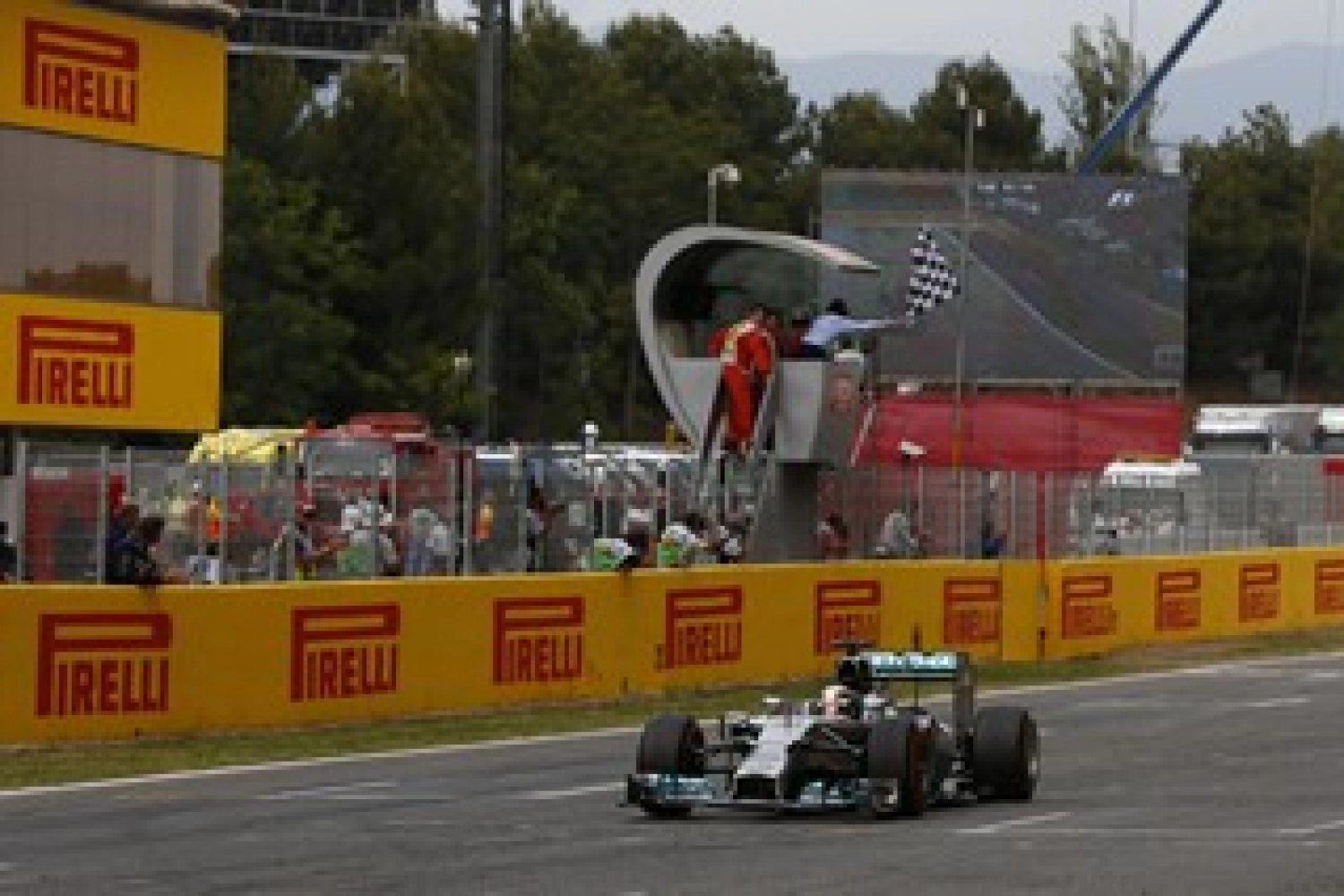
After the Formula 1 Spanish Grand Prix, won by Lewis Hamilton ahead of Nico Rosberg, find the analysis of the tire strategy.

For this Spanish Grand Prix of Formula 1, Pirelli had selected, due to both the abrasiveness of the Catalunya circuit and the stress exerted on the tires by its fast corners, the two hardest compounds in the range, namely the medium and hard tires.
Last season, the Catalan race was marked by a significant number of pit stops, which had been criticized by the F1 world. Fernando Alonso, who won in 2013, made four pit stops.
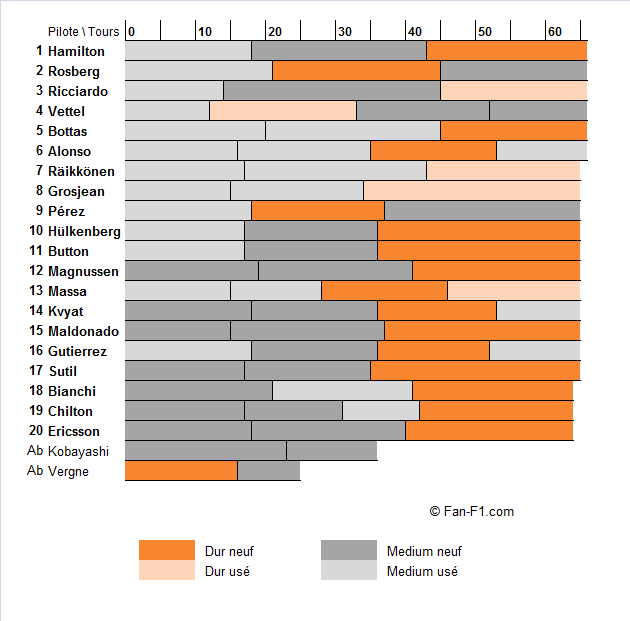
This year, this issue was resolved as most of the drivers (14 out of 20 classified) were able to successfully execute a two-stop strategy, starting with race winner Lewis Hamilton, as well as his two companions on the podium: his teammate Nico Rosberg and Daniel Ricciardo. However, there were disparities within the two-stop strategies. For instance, while the preferred setup was to start the race with two stints on medium tires and finish with a stint on hard tires (Hamilton, Ricciardo, Bottas, Räikkönen, Grosjean, Hülkenberg, Button, Magnussen, Maldonado, Sutil, Bianchi, and Ericsson), two drivers chose to switch to hard tires on the second stint: Nico Rosberg, who glimpsed victory, and Sergio Pérez, who managed to gain an advantage over his teammate at the end of the race.
However, three-stop strategies were possible. Thus, Sebastian Vettel, aiming for an aggressive race, chose to switch to hard tires as early as the second stint to benefit from two sets of new medium tires to attack at the end of the race and secure 4th place after starting 15th. Despite this, it should be noted that this tactical option was not often successful: for instance, Fernando Alonso was only able to overtake his teammate while he was targeting Vettel, Felipe Massa found himself stuck in traffic and finished out of the points. Kvyat, Gutierrez, and Chilton didn’t really have the opportunity to show anything.
Paul Hembery, Pirelli’s Motorsport Director: We saw some exciting battles within the top 10 towards the end of the race, despite the fact that many drivers had chosen very different strategies. This highlights the importance of strategy in each race this year, not just in terms of the number of stops but also because the order in which the tires are used really makes a difference.
After it rained during the night, the ambient and track temperatures were cooler, and this reduced the gap between the hard and medium tires, adding another factor to the equation. Even though Barcelona is one of the most demanding circuits, the tire grip and degradation were under control, as shown by the fact that the majority of drivers made two stops.
Now, we will focus on the second in-season test session of the year, where we will develop tires for 2015.