Red Bull Call: Horner is “extremely confident”
In an interview with Sky Sports, Christian Horner once again expressed confidence regarding the outcome of Red Bull's appeal to the FIA to overturn Daniel Ricciardo's disqualification in Melbourne. He took the opportunity to reaffirm the team's line of defense.

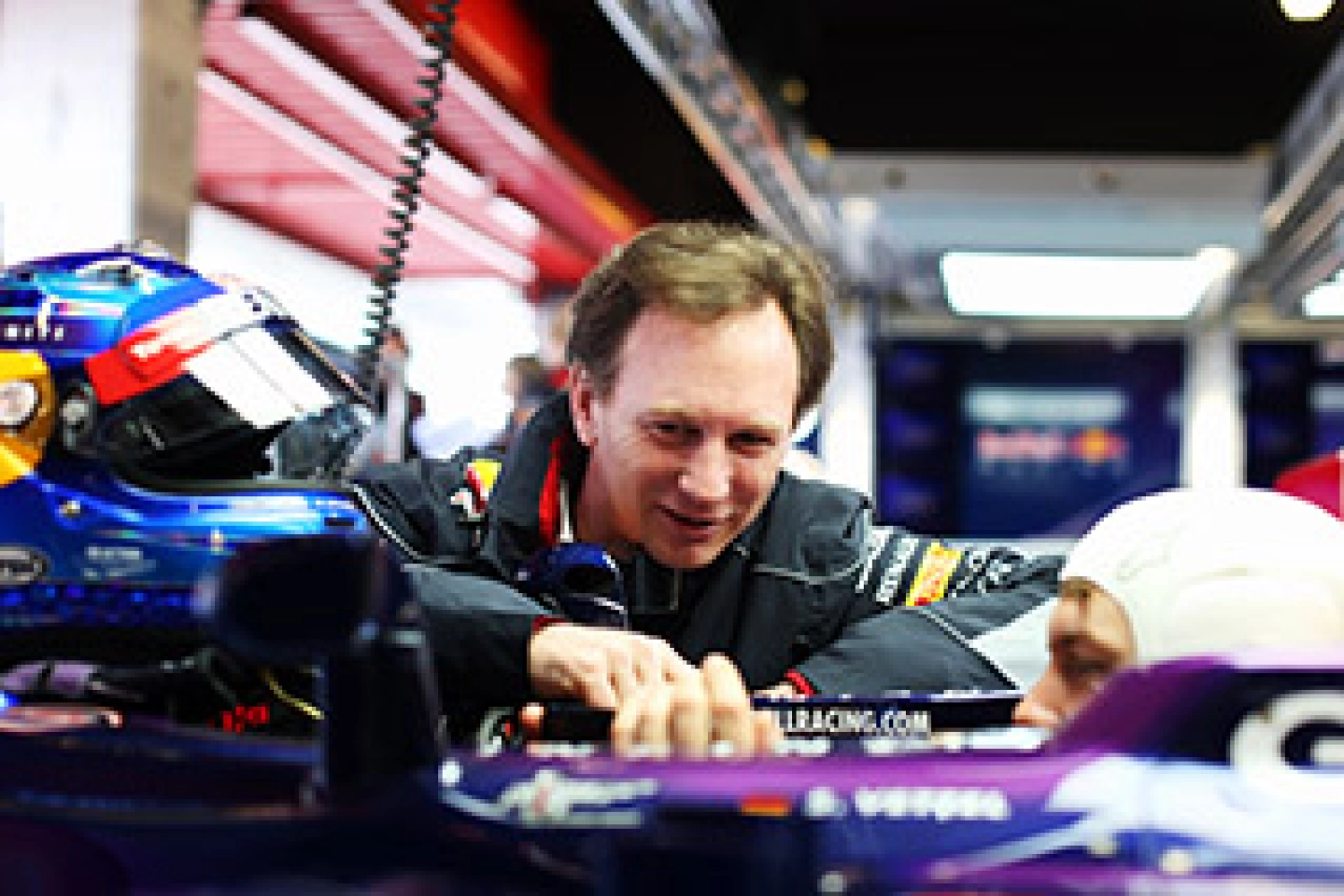
Since the end of the Australian Grand Prix, the controversy over the disqualification of Daniel Ricciardo, who finished second with a car deemed non-compliant by the stewards, keeps growing and is unlikely to be resolved – logically – before April 14, during the hearing before the International Court of Appeal of the Fédération Internationale de l’Automobile in Paris.
Asked by Sky Sports on the matter, Christian Horner, the director of Red Bull, laid out his line of defense: « We are appealing on the grounds that we do not believe, we are extremely confident, that we have not breached the rules, that we have not exceeded the allowed 100kg/h fuel threshold. […] This is the reason for our appeal, we feel that this is an important issue and it will be up to the court of appeal to make a final decision. »
The question raised by the Austrian team is about the accuracy of the fuel flow limit being exceeded: « The whole matter hinges on determining which reading is correct. We have a sensor that is drifting and does not provide accurate values against a fuel flow that we know, which is calibrated, and we know it has not varied throughout the weekend and was subsequently checked and proven not to be defective. It has not been moved or altered at all since it was installed on the car before the weekend. »
The argumentation is therefore based on demonstrating the inefficiency of the sensor that the FIA has established as the only valid instrument: « Our argument is very simple: it’s that we have not violated the technical regulations. That we have not exceeded the fuel flow limit and that the flowmeter, which I hope we will be able to demonstrate on appeal, is incorrect. »
Charlie Whiting’s decisions in question
For Horner, the underlying question is the weight of Charlie Whiting, the FIA’s technical delegate, and the directives he issues, particularly concerning flow meters: « I think the problem with the technical directive is that we’ve seen in the Pirelli tire case or at the time of the double-diffusers, that the directive, as it’s now stated at the bottom of the directives, is the opinion of the Technical Delegate: it’s not a rule, it’s not regulatory, it’s purely an opinion. » As a reminder, the case of the tests organized by Pirelli with Mercedes, in May, also highlighted the role of Charlie Whiting, who had given his agreement for such tests to take place even though the regulations were being breached.
More precisely, the directive in question for the flow meters is the one cited in the commissioners’ decision regarding Ricciardo’s disqualification, at point 8: « Technical Directive 01614 (from March 1, 2014) provides the methodology by which the sensor will be used and, in case it is defective, the method by which the alternative model can be used. [It] starts by stating that: “The homologated flow meter will be the primary measure of fuel flow and will be used to verify compliance with articles 5.1.4 and 5.1.5 of the F1 technical regulations…” It is in accordance with articles 5.10.3 and 5.10.4 of the technical regulations. » Article 5.10.4 of the Regulations specifically states that only one homologated flow meter can be mounted on the car.
The decision continues by stating: « The Technical Directive to continue: “If at any time WE [the FIA] consider that the sensor has an issue that has not been detected by the system, WE will communicate this to the concerned team and we will revert to the backup system. » In Red Bull’s case, no system failure was observed that would have justified considering the backup system to address erroneous measurements from the homologated flow meter (readings of parameters concerning fuel pressure and injection).
Two Grand Prix races will still take place before the hearing, in Malaysia (March 30) and Bahrain (April 6), and the unknown remains as to what attitude Red Bull will adopt regarding the fuel flow calculation. The Brit dodges the question: « I hope we’ll have a sensor that works and works in connection with the fuel flow and that there won’t be this contradiction. Fundamentally, that’s the most important thing, and if there’s a variation or a problem, it’s something we obviously need to discuss with the FIA, and we probably won’t be alone in that. »