Italy: Figures and Technical Data
Overview of the technical constraints imposed by the Monza circuit on the chassis, engine, and tires of Formula 1 cars.

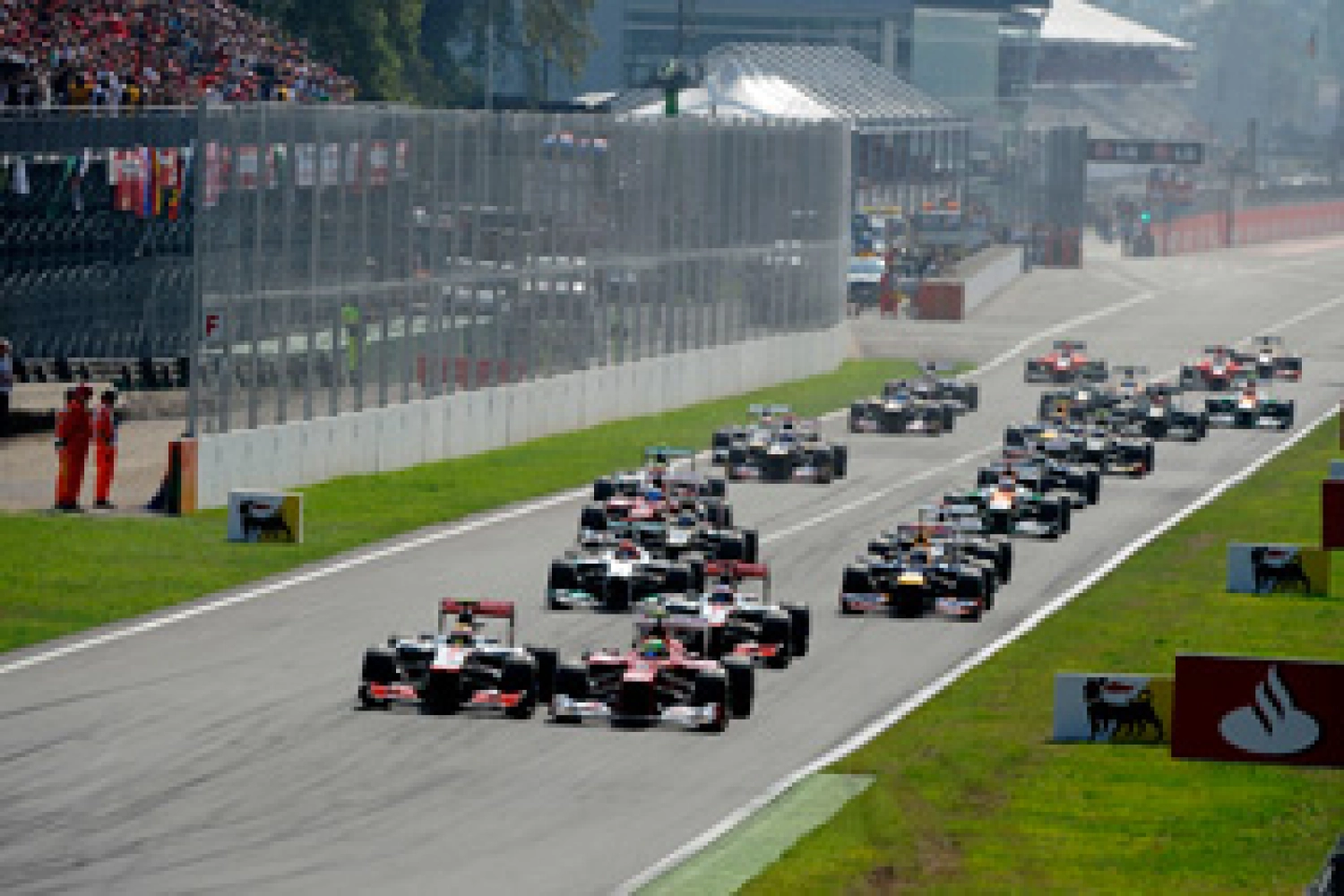
This weekend, F1 heads to Italy, to the temple of speed, Monza. While Sebastian Vettel and Red Bull are dominating F1 at the moment, Monza has not been particularly kind to them. Indeed, although Vettel has won twice – in 2008 with Toro Rosso and in 2011 with Red Bull, the Austrian team has only achieved one podium in Italy out of 16 starts, which was Vettel’s victory. Red Bull’s second-best result is Vettel’s 4th place in 2010.
Vettel is still one of the drivers in the paddock who has performed best at Monza, being one of the three to have won in Italy (2 victories) along with Alonso (2 victories as well) and Lewis Hamilton (1 victory).
The circuit is a fast track where overtaking is possible, especially with DRS, yet pole position seems to be important because since the 2000s, the winner has started 10 times out of 13 from the first position on the grid. Only Michael Schumacher, 2nd on the grid in 2006, and Rubens Barrichello, 4th in 2002 and 5th in 2009, have managed to win without having secured pole.
It is also interesting to note that Peter Gethin, who won in 1971 from the 10th place on the grid, is the driver who won at Monza starting the farthest back. The British driver won after an ultra-close race, the closest ever seen in Formula 1, with the top five drivers separated by only 610 milliseconds! Ronnie Peterson (2nd) finished 10 milliseconds behind, François Cevert (3rd) 90 milliseconds behind, Mike Hailwood (4th) 180 milliseconds behind, and Howden Ganley (5th) 610 milliseconds behind.
The Italian Grand Prix is intimately linked to the Monza Autodrome because the first edition, in 1950, was already held on this track – even though the oval stopped being used over the years. The Grand Prix was only not held at Monza once, in 1980, when the circuit was being renovated; the race took place on the Imola track, which later became the host of the San Marino Grand Prix.
On the opportunities for overtaking, they are plentiful with the slipstreaming phenomenon, but the FIA has nonetheless decided to establish two DRS zones, with two detection points. The first DRS zone is located on the straight before the Ascari chicane, and the second is on the main straight. Regarding the race stewards, Danny Sullivan will be the fourth driver steward.
As for the weather, it should be nice in Monza, even though rain could make an appearance, but not during the various F1 sessions according to this Thursday’s forecasts.
Monza chassis side
Tom McCullough, Head of Track Engineering for the Sauber F1 Team:
« Monza is a unique challenge for drivers and engineers because the circuit’s efficiency requires the lowest drag setup of the season. The track is well known for its long straights. Most of the lack of grip comes from corners taken at medium speed and the two slow chicanes. The circuit is quite bumpy in certain places and you need to use the curbs, so ride quality is an important factor. The circuit tends to favor strategies with few pit stops due to the time lost in the pits. »
Monza engine side
Rémi Taffin, Track Operations Director of Renault Sport F1:
Monza represents the ultimate test for engine performance and reliability. More than three-quarters of the lap are spent at full throttle and speed exceeds 320 km/h on four occasions. The RS27 will be used at full power for nearly 20 seconds on two sections of the circuit, which is twice as much as on a drag strip. Only the downforce generated by the wings prevents the car from taking off. A small airplane would take off at the same speed reached by the cars at the end of the pit straight.
F1 cars will also be racing at their highest average speed of the year, at nearly 240 km/h. The three chicanes break the circuit’s rhythm, and drivers try to stretch their trajectories as much as possible. When the cars jump over the curbs, the internal components are briefly disengaged. These phases of heavy braking and sudden acceleration put enormous stress on every part. That’s why we prefer to use new engines whenever possible.
Although the V8 runs at full throttle for 75% of the lap, fuel consumption is one of the lowest of the season, and the cars therefore start with a relatively low fuel load. This circuit is indeed the most economical of the season, as the engine operates at a constant level for long periods with reduced aerodynamic drag.
However, it is only the ‘reassuring’ area for the engines at Monza! In this race, you will see every engine manufacturer much more nervous than usual…
Monza: the tire side
The available tires for drivers at Monza are as follows:
- Medium (white sidewalls) ;
- Hard (orange sidewalls) ;
- Intermediate (green sidewalls) ;
- Rain (blue sidewalls).
Paul Hembery’s opinion, director of Pirelli Motorsport:
Monza is obviously our home race, just half an hour from our Milan headquarters. It’s easy to understand why this place has been dubbed ‘The Temple of Speed’. It is actually the fastest circuit in the championship, with long straights and fast corners that put a lot of energy into the tires. Overheating and blistering can therefore become an issue if this factor is not well managed.
A correct use of tires can have a very significant effect on the course of the race. This is what teams will assess during Friday’s free practice sessions. Here, it’s not only the performance of the tires being tested but also their durability, due to the numerous high-speed impacts on the curbs – another important aspect of this race. Monza is one of the most popular races of the year, attended by many tifosi, and we are very eager to be there.
Jean Alesi’s opinion, Pirelli ambassador:
I love Monza and I’ve had so many fantastic moments there! I’ve been on pole twice and I think I’ve spent nearly half of my ‘career’ at Monza leading the race, but mechanical issues have gotten in my way! As for the tires, it’s a very demanding race and it’s the fastest circuit of the season; so it’s quite clear that the hardest compounds possible are needed. The cars run with low downforce and can slide a lot in the corners. Limiting this risk is key to saving the tires.
Having good tire pressure is also very important at Monza: you must ensure that it’s not too low. It is crucial for the curbs, in particular, where you hit hard. Nowadays, the driving style means that chicanes are taken almost like straight lines, so having good pressure is even more important than in the past. Monza is also about the tifosi! The support I received from them at the time as a Ferrari driver was fantastic: you could really feel it! In terms of atmosphere, the Monza Grand Prix is truly special!
Monza in numbers
| Length of Monza circuit | 5.793 km |
| Number of turns | 11 (7 right and 4 left) |
| Average speed | 236 km/h |
| Top speed | 331 km/h |
| % of a lap at full throttle | 72 |
| Fuel consumption | 2.5 liters per lap; 62 l/100km |
| Lap record | 1:21.046 (Rubens Barrichello, Ferrari, 2004) |
2012 Italian Grand Prix
Pole position.
Lewis Hamilton (McLaren) in 1:24.010
Podium:
1 – Lewis Hamilton (McLaren)
2 – Sergio Pérez (Sauber)
3 – Fernando Alonso (Ferrari)
Fastest lap in the race:
Nico Rosberg (Mercedes) in 1:27.239
[From the press releases published by the FIA, Pirelli, Renault Sport F1 and Sauber F1]