Canada: Figures and Technical Data
Overview of the technical constraints imposed by the Circuit Gilles-Villeneuve in Montreal on the chassis, engine, and tires of Formula 1 single-seaters.

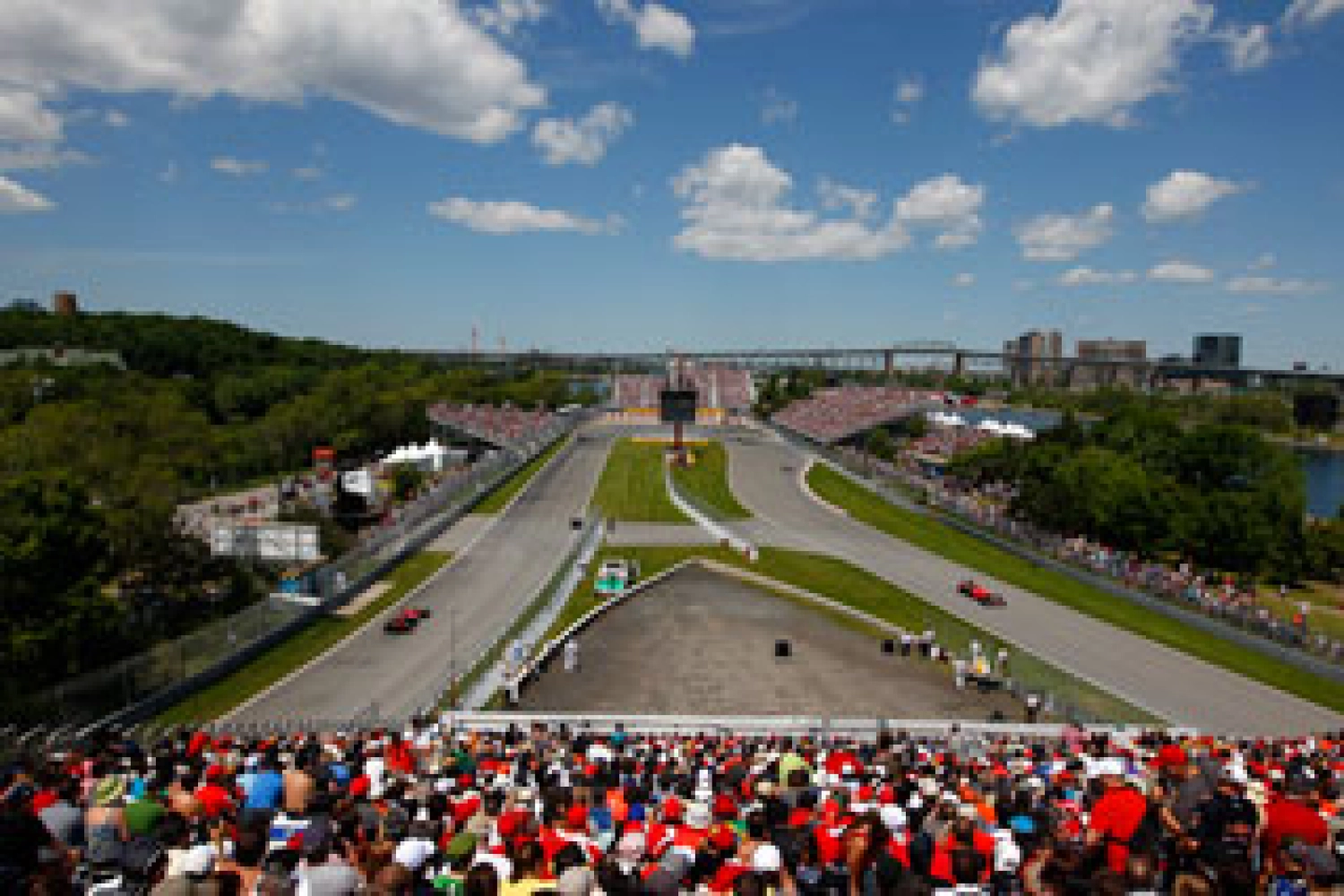
This weekend, for the 7th round of the 2013 Formula 1 season, the Formula One Circus heads to North America, specifically to Canada, for the 44th Canadian Grand Prix in the history of the F1 World Championship.
We should expect to see the same teams at the forefront as in the first races, namely Red Bull, Ferrari, Mercedes, and Lotus. Among the drivers from these teams, only one has won more than once in Montreal, and that’s Lewis Hamilton, victor in 2007, 2010, and 2012. Three drivers, still present on the grid, have each won once in Canada: Kimi Räikkönen in 2005, Fernando Alonso in 2006, and Jenson Button in 2011.
The Gilles Villeneuve track combines long straights with slow corners, providing overtaking opportunities but also challenging the F1 cars and particularly the brakes. Indeed, out of the 7 braking points on the Montreal circuit, drivers experience more than 5G in 4 of them, the most difficult being the hairpin where drivers go from 300 km/h to 60.
Unlike the last Grand Prix held in Monaco, in Canada, starting from pole position doesn’t offer a particular advantage in terms of winning, as only 4 of the last 12 pole-sitters have won. However, starting from the front row does offer an advantage, as 8 of the last 12 winners have started from the first two rows. Yet, remarkable feats are still possible in Montreal, such as Jenson Button’s achievement during his 2011 victory, when by lap 40 out of 70, the Briton was in last place and managed to climb up to secure the win.
On the FIA’s side, Martin Donnelly will be the driver steward this weekend in Montreal. It should also be noted that on the Gilles-Villeneuve circuit, the FIA has decided to set up two DRS zones, on the long straight before the pits and on the pit straight, but there will only be one detection point, which will be located before the hairpin at turn 10.
Montreal by the Chassis Side
Tom McCullough, Head of Track Engineering for Sauber F1 Team:
The Montreal circuit is very narrow and has walls very close to the track. This generally produces one of the most exciting races of the season, and the intervention of the safety car is very likely. The circuit is a compromise between long straights and slow corners, which encourages overtaking and also contributes to being one of the toughest circuits for brakes.
The efficiency of the circuit requires a low level of drag for the rear wing compared to Monaco, but you still need a car that performs well in slow corners. This year, the mediums replace the softs as the hardest compound, while the super-softs remain the softest.
Montreal engine-side
Rémi Taffin, Track Operations Director of Renault Sport F1:
« After the slowest track on the calendar, we are going to race on the circuit with the shortest lap time. It takes an average of only 75 seconds to complete a lap of the Circuit Gilles Villeneuve. This is due to both the short length of the track—just over four kilometers—and the long straights, which account for a particularly high percentage. Therefore, we focus on acceleration and top speed.
The straight lines are connected by tight hairpins, where cars slow down to less than 60 km/h. Our challenge is to combine this high top speed with effective engine braking and good acceleration for entry and exit from tight corners. It is also important to consider that both the hairpins and the chicane subject the engine components to violent lateral acceleration forces, three times per lap. This is what has given Montreal its reputation as an engine-breaking circuit.
This succession of heavy braking and acceleration phases leads us to carry one of the highest amounts of fuel of the season, as in Abu Dhabi and Australia. This will be influenced to some extent by race strategies and the weather, which is proving to be very uncertain this year.
Montreal from the tire side
The available tires for the drivers in Montreal are as follows:
- Ultra-Soft (red walls) ;
- Medium (white walls) ;
- Intermediate (green walls) ;
- Wet (blue walls).
Opinion of Paul Hembery, Director of Pirelli Motorsport:
Canada is always one of the most unpredictable races of the season, partly due to the high tire challenge, largely because of the heavy braking and significant traction demands of the circuit. Combined with a significant level of evolution throughout the weekend, effective tire management has been the key to success in Montreal since its inauguration in the late 1970s.
We expect two or three pit stops per car during the race, but we will only be able to make precise predictions at the end of Friday, after track running. It is a circuit where weather conditions often play a crucial role: our first Canadian GP in 2011 turned out to be the longest race in Formula 1 history due to heavy rain and long race interruptions. Last year was a dry race, but we witnessed a new record with a seventh different winner in seven races.
Due to the significant level of wear and degradation, we expect to see different strategies at play, as last year, with teams deciding to opt for a sprint strategy or making fewer stops by focusing on endurance. Last year, the sprint approach paid off, but with so many factors at play, teams will need to analyze the data—let alone the weather—with great attention before committing to any tactic. A flexible approach often works best in Canada, and we can expect many teams to keep options open to allow drivers to really make a difference when it matters.
Opinion of Jean Alesi, Pirelli ambassador:
The Canada will always be an incredible place for me, as it is, of course, where I won the race in 1995, with Ferrari, and Gilles Villeneuve’s number 27. It’s hard to describe those emotions, but it was just a wonderful feeling and joy in an amazing atmosphere, with the crowd running onto the track after the race… Canada is always a place where the fans are absolutely fantastic; it’s a great feeling to be in a country where F1 is welcomed with so much enthusiasm.
For a driver, it is also truly a great challenge. Many grandstands and walls are so close to the track that you feel somewhat like in Monaco. But of course, you drive much faster than in Monaco, and that’s why it’s also difficult for the tires. The main characteristic is acceleration/braking: you really cover a wide range of speeds, foot to the floor on the straights, to very slow corners. It’s important to manage the tires and have a good strategy to cope with these demands. I think we’ll see a fantastic race; it’s a Grand Prix that I’m really looking forward to.
Montreal by the Numbers
| Length of the Gilles-Villeneuve Circuit | 4.361 km |
| Number of corners | 14 (8 right and 6 left) |
| Average speed | 199 km/h |
| Top speed | 317 km/h |
| % of a lap at full power | 57 |
| Fuel consumption | 2 liters per lap; 66 l/100km |
| Lap record | 1:13.622 (Rubens Barrichello, Ferrari, 2004) |
The 2012 Canadian Grand Prix
Pole position:
Sebastian Vettel (Red Bull) in 1:13.784
Podium:
1 – Lewis Hamilton (McLaren)
2 – Romain Grosjean (Lotus)
3 – Sergio Pérez (Sauber)
Fastest lap in race:
Sebastian Vettel (Red Bull) in 1:15.752
[From the press releases published by the FIA, Pirelli, Renault Sport F1, and Sauber F1]