Malaysia: Figures and Technical Data
A brief overview of the technical challenges that the Sepang circuit in Malaysia imposes on the chassis, engine, and tires of Formula 1 cars.

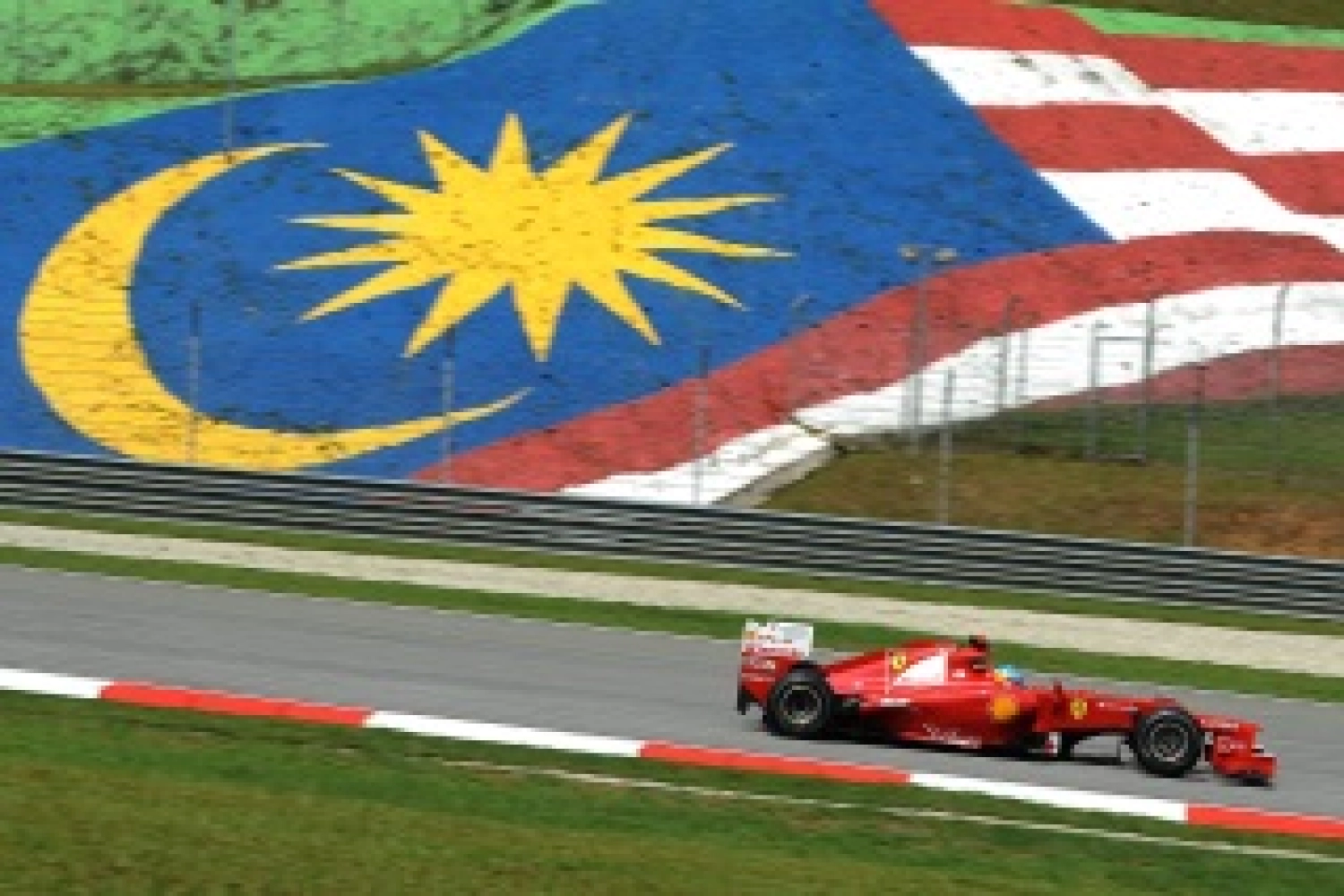
For the second race of the 2013 Formula 1 season, the Formula One Circus stops in Sepang, Malaysia. This Asian country will celebrate this year the 15th anniversary of the first Malaysian Grand Prix in Formula 1, held in 1999 and won by Eddie Irvine at the wheel of his Ferrari F399.
The circuit has an atypical layout, with quite an interesting elevation change for the drivers, especially in the second half of the lap. It also features two long straights where drivers will have the opportunity to activate their DRS.
In terms of numbers, this Malaysian Grand Prix will be Fernando Alonso’s 200th Formula 1 Grand Prix. The Ferrari driver, who won last year from 8th place on the grid – the farthest position from which a winner has emerged in Malaysia, will attempt to secure another victory on a circuit where he has already won three times – with three different teams, Renault in 2005, McLaren in 2007, and Ferrari in 2012.
The weather conditions will be challenging in Malaysia this weekend. Indeed, temperatures are expected to range between 25°C and 34°C, and storms accompanied by rain are forecasted for the weekend, which could offer spectators and viewers an unrestrained race like last year.
Sepang chassis side
Tom McCullough, Head of Track Engineering at Sauber F1 Team:
« The Sepang circuit is a track with medium and high speeds […]. The circuit is technically demanding because there are also two long straights that require an efficient car, as well as some slow corners. The characteristics of the circuit and the usual high temperatures are also a real challenge for the tires, which is why Pirelli will bring medium and hard compounds. The weather can also play a significant role during the race weekend as showers are frequent in the late afternoon. »
Sepang engine side
Rémi Taffin, Director of Track Operations at Renault Sport F1:
« After an initial victory in Melbourne, we quickly focused on Sepang. This 5.543-kilometer circuit is a challenge for engines. A large part of the lap is run at full throttle, especially on the two long straights. Each time, the engine is at 100% for more than ten seconds. It is necessary to combine good acceleration with a good top speed. The two straights are run in opposite directions; this is a parameter to consider when selecting the seventh gear ratio. If there’s a tailwind on one straight, acceleration can be compromised on the other if the ratios are not well calculated.
There are also several low or medium speed corners. The engine must be flexible enough to be responsive at the apex and on corner exit. In particular, the first corner requires great stability under braking before a brief acceleration for the long fast curve that follows. Engineers must find the best compromise with the overrun to help the driver turn without compromising the pickup.
But the main characteristic of Sepang is the ambient humidity. Even if it doesn’t rain, the degree of humidity alters the properties of oxygen and slows down the combustion process, consequently reducing engine power. If it rains, as it has every year so far, the challenge is to establish parameters to limit this power loss while maintaining sufficient grip. The Renault Sport F1 engineers will propose a specific rain mapping so that the driver can utilize the torque. We will monitor the data provided by the sensors to verify that the actual torque delivered matches what the driver demands. This is particularly important in fast corners, mainly between 9 and 13.
In addition to the intrinsic difficulty of the track, we also have to consider engine management strategy throughout the season. In Melbourne, we used a first engine. Arriving in Sepang, we have two options: keep the same engine for a second consecutive weekend – it would reach 1,600 kilometers by the end of Malaysia – or install a new engine for Saturday and Sunday. This second option gives us more flexibility to work during Friday’s session. Both strategies will be discussed in Sepang. We will therefore have a lot of information on how teams handle this issue.
Sepang tire side
The tires available for the drivers at Sepang are as follows:
- Mediums (white sidewalls) ;
- Hards (orange sidewalls) ;
- Intermediates (green sidewalls) ;
- Wet (blue sidewalls).
Paul Hembery’s opinion, director of Pirelli Motorsport:
« We would describe Sepang as a truly “extreme” circuit, both in terms of weather and track surface. This means it is one of the most demanding weekends for our tires all season. We will see the new P Zero Orange compound in competition for the first time. This color (instead of silver) was chosen to make it easier to distinguish from the white mediums on television. The choice made for Malaysia is the same as last year, but the compounds themselves offer more performance and have a deliberately higher level of degradation this year.
Last year, three pit stops were the winning strategy under mixed conditions, at the end of a thrilling finish between Fernando Alonso and Sergio Pérez, influenced by the tires. We expect three stops again, but once more, the weather might overshadow the action. Even if it doesn’t rain, drivers are preparing for humidity levels around 80% and ambient temperatures above 30°C.
Opinion of Jean Alesi, Pirelli ambassador:
I participated in the Malaysian Grand Prix twice: the first time in its inaugural year, 1999, and the second in 2000, for my last season in Formula 1. Both times, I reached the finish, but I remember how challenging it was for both the drivers and the cars: it is one of the most physically demanding races on the calendar.
Like Albert Park, Sepang is not a “typical” circuit, and what we will see this weekend will probably not be representative of the rest of the season. Nevertheless, it certainly shows which driver has a good car and a good ability to manage tires. With more degradation this year, knowing how to manage the tires becomes even more important—as it has always been in Formula 1—and the Malaysian Grand Prix emphasizes this point. If it starts to rain really hard, there’s really nothing you can do: you just have to try to survive! We could have very interesting results depending on who makes the right tire choices.
Sepang in numbers
| Length of Sepang Circuit | 5.543 km |
| Number of turns | 15 (10 right and 5 left) |
| Average speed | 197 km/h |
| Top speed | 311 km/h |
| % of a lap at full throttle | 59 |
| Fuel consumption | 2.45 liters per lap; 63 l/100km |
| Lap record | 1:34.223 (Juan-Pablo Montoya, Williams-BMW, 2004) |
The 2012 Malaysian Grand Prix
Pole position.
Lewis Hamilton (McLaren) in 1:36.219
Podium:
1 – Fernando Alonso (Ferrari)
2 – Sergio Pérez (Sauber)
3 – Lewis Hamilton (McLaren)
Fastest lap in the race:
Kimi Räikkönen (Lotus) in 1:40.722
[From the press releases published by the FIA, Pirelli, Renault Sport F1 and Sauber F1]