South Korea: Figures and Technical Data
A brief overview of the technical constraints imposed by the Yeongam circuit on the chassis, engine, and tires of Formula One cars.

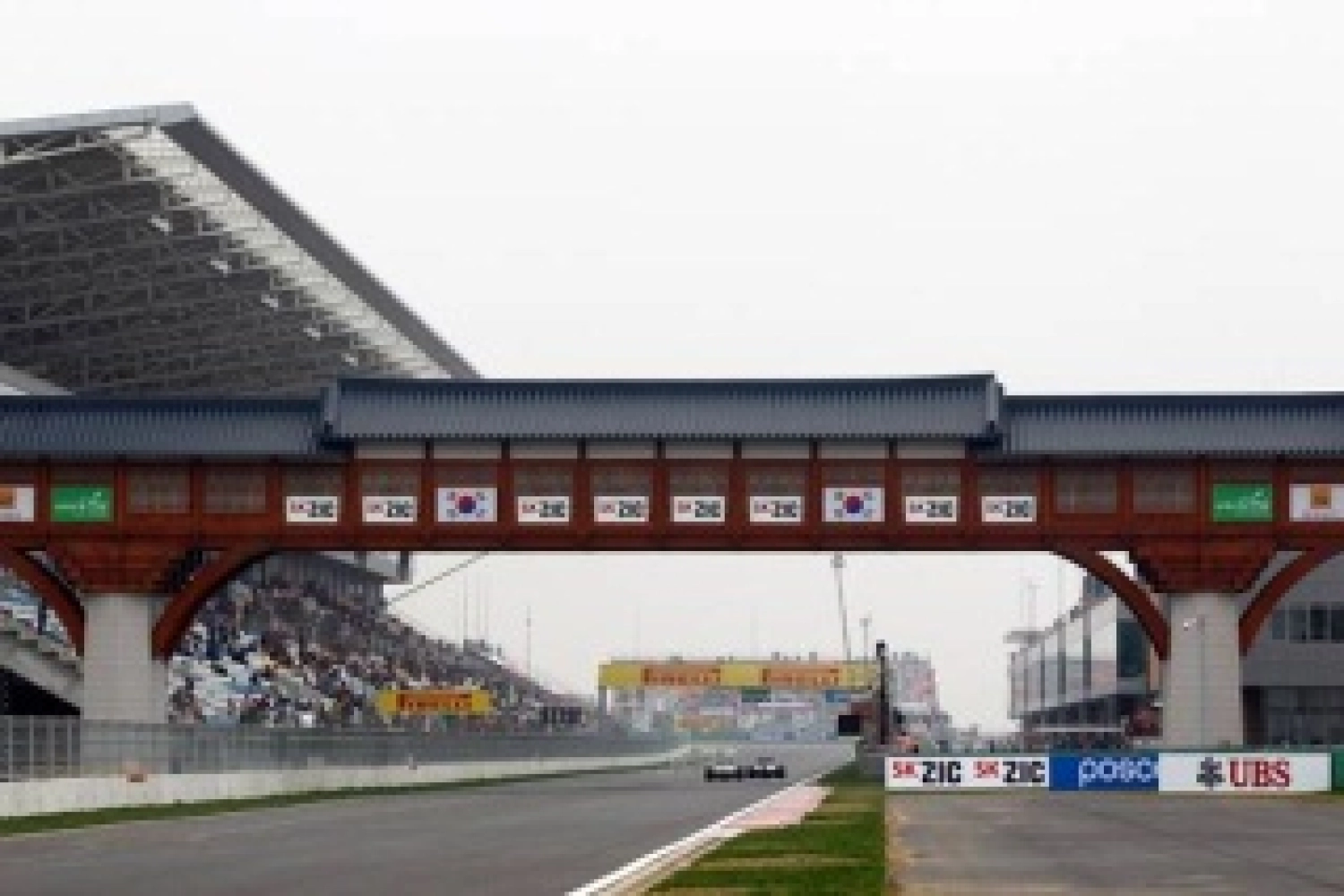
Formula 1 will be heading to South Korea for the third time in its history, at the Yeongam circuit this weekend. Unlike the past two years, the weather is expected to be milder and there should be no rain at all during the various sessions scheduled from Friday to Sunday.
The Yeongam Circuit, or Korea International Circuit, was designed by the famous German architect Hermann Tilke and incorporates many different features, such as slow corners, fast sections, straight lines, and a winding section with walls. All this makes it interesting for drivers and challenging for engineers in terms of finding the best settings.
With several straight lines, this circuit is the perfect tool for DRS, and the FIA has decided to extend the DRS zone on the South Korean track by 80 meters. Detection will occur slightly before turn 1, and usage will be possible after turn 2, on the longest straight of the circuit, as it was last year. On the side of the track officials, it’s Martin Donnelly, former Arrows and Team Lotus driver, who will serve as the FIA’s 4th steward.
On the championship side, the Korean Grand Prix marks the beginning of the final stretch of the season, the first of the five remaining Grand Prix that will determine the 2012 Formula 1 world champion and the team that will win the constructors’ trophy.
Yeongam side chassis
Giampaolo Dall’Ara, Head of Track Engineering at Sauber F1 Team:
« The Yeongam circuit is a modern track that has a bit of everything. The first sector features three straights with two sharp-angle turns in between, and also a slow section with tight corners at the end. Then, the second sector has turns approached at medium and high speed before returning to the third sector, which is twisty. The asphalt is not very abrasive, and the Pirelli tires brought are the Soft and Super Soft, which should be fine. However, grip builds up quite slowly over the weekend because there are hardly any support races. »
Yeongam engine side
Rémi Taffin, Director of Track Operations at Renault Sport F1:
« The Japanese and Korean Grand Prix are geographically and temporally close, but they also share common characteristics. Like Japan, Korea requires good top speed and optimal acceleration to achieve it, especially in the first sector. There are three long straights, so it will be essential that we have worked well to ensure the engine delivers what is expected, both in terms of top speed and acceleration. Although the engine is at full load for 80% of the time spent in this sector, it is not subjected to too harsh a test, as the cooling and lubrication systems do not undergo lateral pressure.
In the second sector, the single-seater will need to develop torque, have good traction, and possess an effective engine brake. There are particularly fast corners, especially in the first part of the sector, driving the engine with the inertia of frequent changes in direction. This is not very different from Suzuka in this regard, especially the section between corners 6 and 9, whose characteristics are similar to those of the Esses.
The third sector is a sequence of braking and acceleration, especially around right-angle corners, which significantly increases fuel consumption over a lap. The Korean circuit is like a combination of three different tracks. The challenge is to tune the engine so that it can correspond to each of the three sectors without disadvantaging the driver in any portion.
The championship being very competitive and entering its final phase, we expect a lot from this event. We can also make an impression since, in Japan, Sebastian Vettel recorded the 199th pole position for a Renault engine. We are now on the hunt for the 200th!
Yeongam on the tire side
The opinion of Paul Hembery, director of Pirelli Motorsport:
« We are bringing the same tires as last year for Korea. At the time, it was considered bold because the level of lateral energy loads throughout the circuit is highest on the super soft tire. But in the end, we saw the super soft tire last 10 laps or more and the soft tire last 20 laps or more, allowing a two-stop strategy for the majority of drivers. This year, however, all our F1 tires are softer, with the exception of the super soft, which has remained the same. We should again see two-stop strategies, which should theoretically make the race faster.
This year, changes related to aerodynamic regulations have occurred, slowing lap times throughout the season. Strategy played a key role in last year’s races, but the safety car also made an appearance, and rain intervened at the start of the weekend. Korea is therefore the type of circuit where anything can happen, and as always, the teams gathering the most data and having the ability to adapt this information to make quick changes to circumstances will find success there.
Jaime Alguersuari’s opinion, Pirelli test driver:
South Korea is one of my favorite circuits, particularly because it was the site of one of my best results last year when I passed Nico Rosberg on the last lap to finish seventh. I really love the track: the layout is fantastic, and I think it’s one of the best on the F1 calendar. It’s a mix of high and medium-speed corners, and the downforce on the car is not so high. It is also very fluid and offers good overtaking opportunities. From a tire perspective, the circuit is gentle on the tires because the weather is usually quite cool and damp. We made two stops last year, and the degradation will be low, so I think we should see the same thing this year. There are three big braking zones on the circuit, and it will be a fantastic race to watch: the South Korea circuit has the potential to offer a perfect F1 show.
Yeongam in figures
1:39.605: This is the lap record set by Sebastian Vettel in 2011 at the wheel of his RB7.
3.5: This is the highest G-force that drivers will have to face onboard their F1 cars.
**14.4:** In seconds, it is the longest portion spent flat-out by drivers on the Yeongam circuit.
62%: This is the percentage of the lap spent at full throttle by the drivers.
310: This is, in km/h, the maximum speed that F1 cars are expected to reach on the South Korean circuit.
1050: This is, in meters, the length of the longest straight line at the Yeongam circuit. It is the 4th longest straight of the season, after those in Shanghai (1170m), Abu Dhabi (1140m), and Monza (1120m).
[From the press releases published by FIA, McLaren, Pirelli, Renault Sport F1, and Sauber F1]