Singapore: The Pilots’ Perspective
« Strange », « Remarkably unusual », « Fabulous », « Fascinating », « Unique », etc. These are the adjectives that come to mind for drivers when talking about the Singapore Grand Prix.

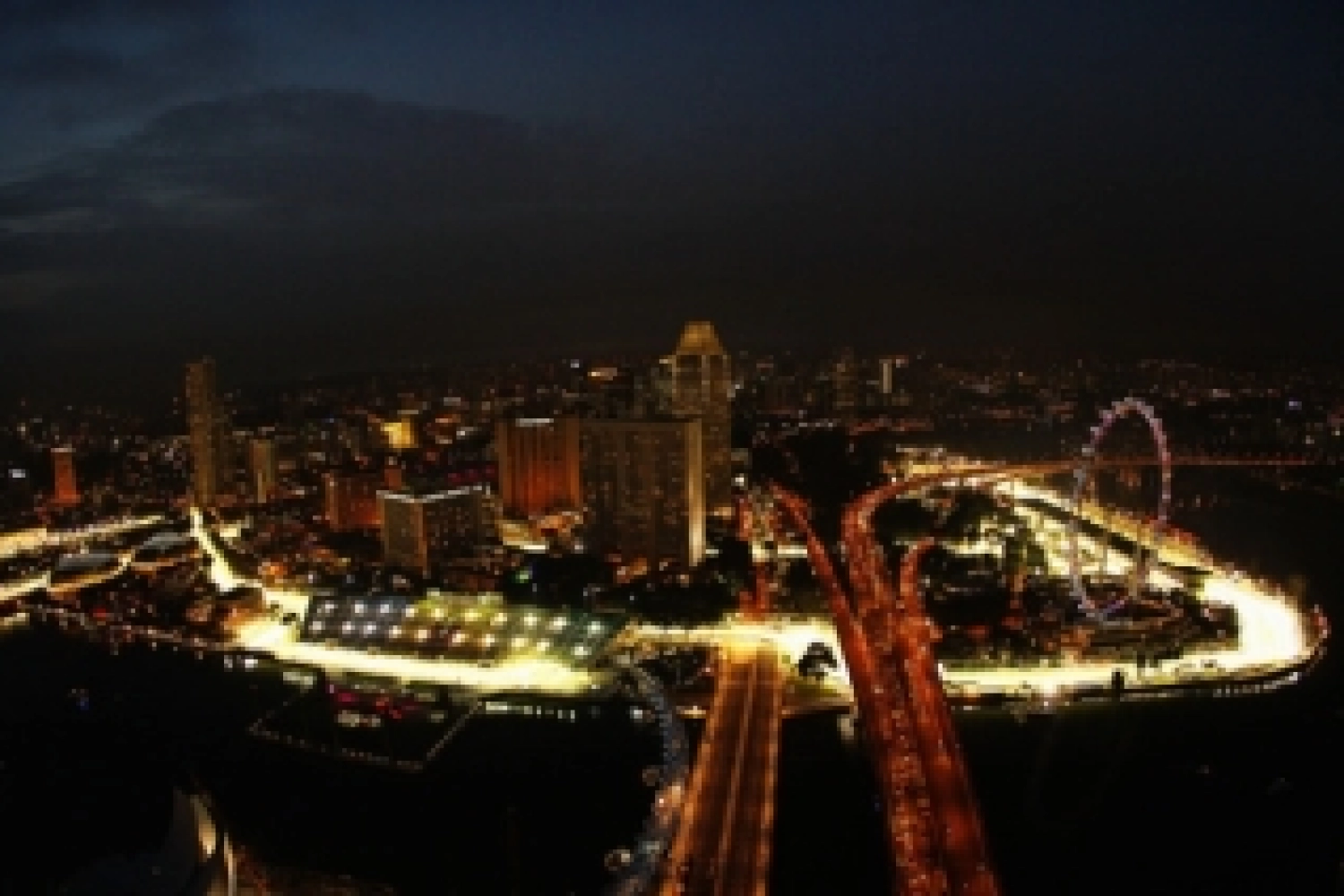
Since 2008, Formula One has been meeting in the streets of Singapore for a unique race held under a starry sky, at a time when everything that lives, exists, or thinks watches with anxiety as this dark silence advances into this dark immensity. The event quickly won hearts in the premier category, starting with Sebastian Vettel’s, who will be defending his title there after winning last year: « Singapore is one of the key events on the calendar because the atmosphere of a night race is incredible. I also love this event because the track is really pleasant to drive, partly because it runs counterclockwise. »
For his part, Michael Schumacher, who discovered the Marina Bay circuit for the first time in 2010, the year of his return to competition, speaks of a superbly unusual race: At first glance, everything seems more relaxed because the action takes place at night, but of course, that’s not the case at all. The reality is that you have to work hard to stay on European schedules and maintain the right biorhythms so that you perform well in the race—because it’s unusual to race at this time of day. Interestingly, the circuit is very technically demanding, and it’s very challenging to complete a perfect lap.
While for Nico Rosberg, the Singapore Grand Prix is one of the highlights of the season and it’s a really fun weekend, for Kamui Kobayashi, Singapore is a really special event: As a night race, it has established itself as a key moment of the season. Personally, I love the place. It’s not very far from my birthplace, and there are always a lot of Japanese fans.
If Mark Webber highlights the fact that everyone enters this meeting with passion, he also notes the proximity of the city-state to his country: I also like the fact that we have some Australians coming, especially from the West Coast because it’s easy by plane. It’s quite unique. Moreover, like the native of Queanbeyan, who loves coming to Singapore because it’s clean and safe, many drivers enjoy going to the micro-state, where everything is order and beauty, luxury, calm, and voluptuousness. If for Nico Rosberg, the city is simply fantastic, for Sebastian Vettel, Singapore is a fascinating city to visit, and everything seems incredibly clean and tidy. The same goes for Pastor Maldonado, who claims it’s a very pleasant city with a good atmosphere, while Romain Grosjean finds it very cool, and Kimi Räikkönen claims to enjoy the local cuisine.
But the main originality of the Marina Bay circuit obviously lies in the fact that the Grand Prix takes place there at night. « It always seems strange to race at night, to go to bed at 5 a.m. and wake up in the afternoon, but it’s surprising how easy it is to adapt, » notes Nico Rosberg. And Kimi Räikkönen adds: « The first two years, I was a bit surprised that people talked so much about the schedule. When the lights are on, it’s exactly like daytime. I think everyone in F1 is excited to race at night in Singapore. The effect is very successful because it’s a very lively city and a lot of people come to watch. Apart from one or two slightly dark spots in the escapes, the circuit is very well lit. So it doesn’t make a big difference from a daytime race. » Moreover, according to Paul di Resta, « it’s almost better than racing during the day under a cloudy sky »: « They do such a good job that you don’t really notice it. »
But as Sergio Pérez points out, due to this nighttime schedule, we race at night and live at night during the Singapore Grand Prix. For this reason, the drivers and team members stick to European timetables, which doesn’t pose too much of a challenge in the eyes of Paul di Resta: The important thing is to make sure you choose the right flight to arrive in Singapore at the right time of day. You also need to ensure that hotel staff don’t knock on your door at nine in the morning because you still have five hours of sleep left. I always go to bed at six in the morning to get up at two in the afternoon: that’s my routine.
Mark Webber reminds us, however, that the Singapore Grand Prix is not just a flimsy backdrop but also – and above all – a very, very demanding track. Thus, while Narain Karthikeyan notes that Singapore has a spectacular atmosphere due to the night and artificial lights, he emphasizes that the Marina Bay street circuit is very bumpy and complex: You cannot afford the slightest mistake because it’s a street circuit. It is also a very demanding circuit from a physical standpoint due to the high temperatures and humidity.
Thus, according to Jenson Button, the Marina Bay circuit is unique: There are some long straights, so it’s very fast, but all the corners are generally taken in second or third gear, so you have to find the best compromise in terms of settings – especially since you need a good top speed to overtake at turn 7. It’s the best overtaking opportunity as it comes at the end of the DRS zone. On the other side of the McLaren stand, Lewis Hamilton appreciates the Singapore circuit as much as the Hungaroring because it’s a complicated circuit that requires you to be completely in tune with the car to get the best out of it: It requires finesse; all the braking zones are approached at high speed, and the walls are never far away. With the heat and humidity, it makes for a very demanding weekend.
Nico Hülkenberg particularly insists on the physical and mental challenge that the Singapore circuit represents: « It is a very long track with bumps and quite tricky curbs, and you really have to flirt with the walls if you want to be fast. Therefore, achieving the perfect lap is not easy. The circuit also runs counterclockwise, although it is not as hard on the neck as Interlagos because most of the turns are slow or medium speed. For me, Singapore is the toughest race of the year, both physically and mentally. I think it is because there are 23 turns and it is one of the longest races of the year, always at the limit of the two-hour regulations. You feel it after the race because of the high temperatures and humidity. »
The final word will go to Nico Rosberg, who will no doubt hope to repeat his 2008 podium: « It’s a city circuit with intense heat and humidity, the large number of turns, and the race under artificial light, it’s really a challenge. »