Germany: Figures and Technical Data
Overview of the technical constraints imposed by the Hockenheim circuit on the chassis, engine, and tires of Formula One cars.

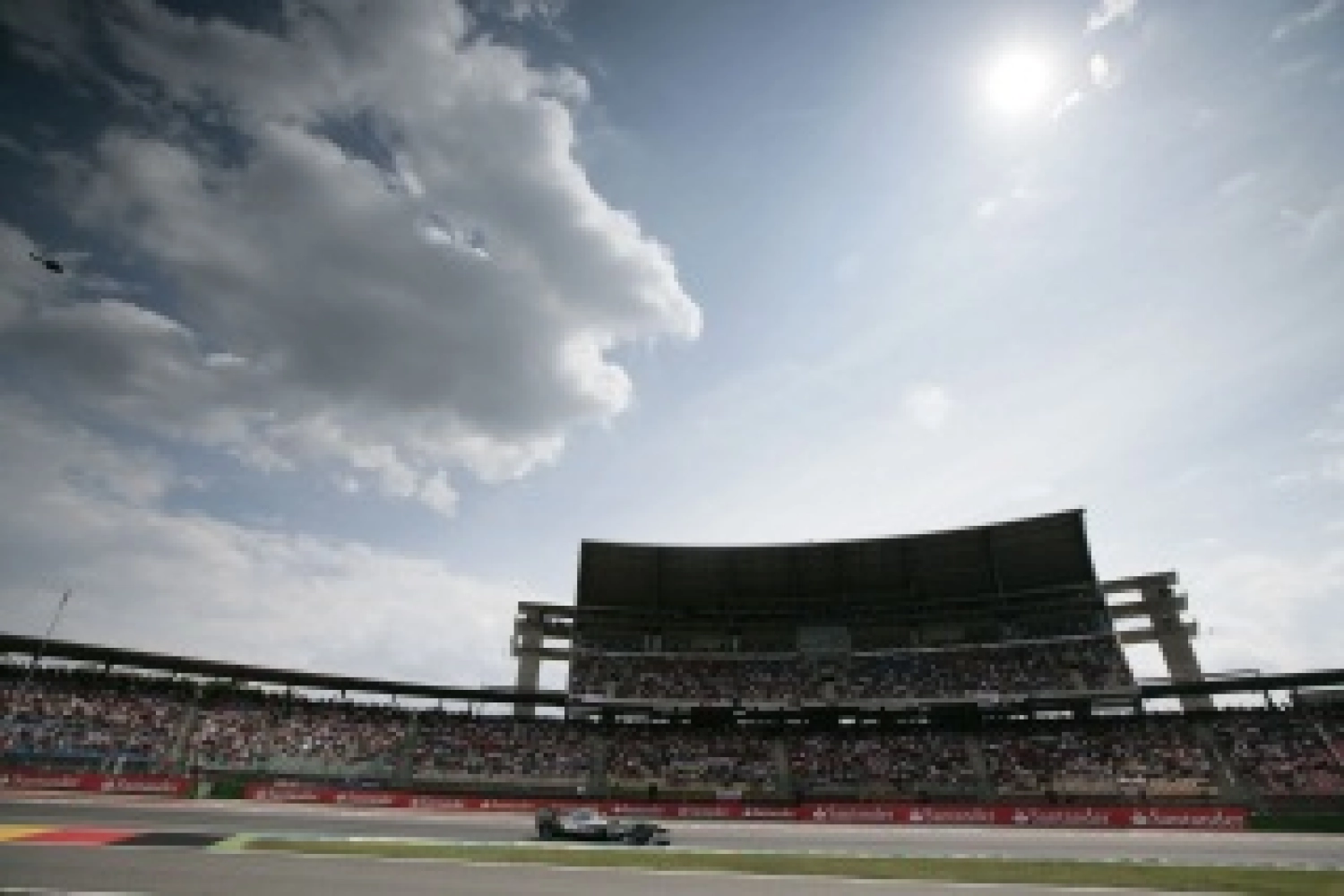
The German Grand Prix of Formula 1 is alternately held between the Nürburgring and Hockenheim circuits. This year, the F1 paddock will head to Hockenheim, which will notably be the debut of the DRS on this track.
The German circuit is a rather fast circuit – the average speed on a lap is around 220 km/h – but it requires significant downforce for the Stadium section, which is much more winding and technical than the rest of the track, as well as for traction on corner exits. Properly setting up the car will be a challenge because it’s necessary to find the right balance between being fast on the straights and having enough downforce to effectively handle this final part of the lap.
On the statistical side, the German Grand Prix has never really been successful for local drivers – who are often very numerous and this year again, with five German representatives: Sebastian Vettel, Nico Rosberg, Michael Schumacher, Nico Hülkenberg, and Timo Glock. Indeed, only two German drivers have managed to win at home in the history of the Formula 1 World Championship: Ralf and Michael Schumacher. Sebastian Vettel will undoubtedly try to join them this weekend for what would be his first home victory in F1.
Hockenheim chassis side
Giampaolo Dall’Ara, Head of Track Engineering:
« We haven’t raced at Hockenheim since 2010, so this will be the first time we will be using Pirelli tires and DRS there. On average, the characteristics it demands are closer to those of Valencia. Braking stability and traction are important, but you also need top speed, particularly in the Parabolica, where overtaking should be possible.
The asphalt of Hockenheim is very smooth. Pirelli has chosen the Soft and Medium tires, which at first glance seems to be a conservative choice. But temperatures can be high in July at Hockenheim, so we’ll see how this affects the tires.
Hockenheim: engine side
Rémi Taffin, Head of Track Operations at Renault Sport F1:
« The Hockenheimring represents a challenge for Renault. We do not visit this circuit every year and only have data from two years ago. In two years, an F1 chassis evolves significantly, as does the way we make the engine interact with its environment. Therefore, we need to simulate the effects of the circuit on our new package, even more so than for other tracks. Consequently, we need to work harder on Thursday and Friday to verify what we observed on the test bench and simulator.
The characteristics of Hockenheim are quite similar to those of Silverstone. The track is very flat. There are long straights that require a high maximum speed… But there are also corners with different passage speeds that demand the engine at different power levels.
We will use the same engines as at Silverstone for most of our partners. We are optimizing the engine allocation for each car throughout the season. After the summer break, we will head to Spa and Monza, two circuits where engine power significantly impacts performance. Therefore, we prefer to keep unused engines in reserve for these events rather than for Hockenheim, where power impact is less significant.
The last thing to note this year in Germany is the weather. Normally, we experience high temperatures there. This year, we are expecting cooler temperatures, around 16-20°C, instead of the usual 30°C. It doesn’t change much in the way we use the engine. But we will still need to closely monitor the settings. It will be an interesting Grand Prix.
Hockenheim on the tire side
Paul Hembery’s opinion, director of Pirelli Motorsport:
« After the wet weather at Silverstone, we hope to offer drivers a chance to run with the experimental hard compound during free practice in Hockenheim. However, the weather in Germany can be as unpredictable as it was in England at this time of year: when we came for GP3 two years ago, we had a lot of rain, although it was also very hot.
The new hard compound is not a major evolution, but it benefits from a wider operating window, which should make heating them up and keeping them in the right window easier for the teams. We will use them on Friday, only during free practice sessions, because the championship is so balanced that we feel it would be unfair to suddenly alter one of the fundamental parameters, for which the teams put in so much effort to understand. However, we appreciate the productive dialogue with them, and we always take into account the wishes of the majority. It will be interesting to hear what everyone has to say about the new tires and to see if their impressions match the conclusions from our private testing.
Coming to a new circuit creates a different challenge for us, as we don’t have any comparison data. However, the progress made in simulation has been incredible: nowadays, you can learn so much about a tire’s behavior on a circuit, even without going there! These modern reproduction techniques clearly show how our involvement in Formula 1 helps us improve our road products every day.
Lucas di Grassi’s opinion, Pirelli test driver:
« My personal memories of Hockenheim are mixed: I had the biggest accident of my career there in Formula 3, in 2005, when I touched the wheels of another car and took off, head down, straight towards a barrier. But I also climbed the podium twice in GP2 there!
Unlike the old Hockenheim, the modern track doesn’t have a specific feature that pushes the tires to the maximum; rather, it is a combination of factors. There are large braking zones, with a lot of energy going into the tires, and a stadium section heavily reliant on lateral grip. Understeer can occur when the tire begins to degrade, but the main limiting factor is the significant traction. Much will of course depend on the temperatures, and anything is possible at Hockenheim.
It will be interesting to see what people think of the experimental compound I helped develop. Unfortunately, we will not be able to compare it to the current hard compound, which is not selected for Germany, but I think the drivers will like it: it offers more traction, especially at low temperatures.
Hockenheim in numbers
1:13.780: This is the lap record at Hockenheim, set by Kimi Räikkönen in 2004 when he was driving for the McLaren Mercedes team.
4: This is the number of German Grand Prix victories that Michael Schumacher managed to secure in his career. He is the most prolific driver in the history of the F1 World Championship at the German GP.
4.5: This is the maximum number of Gs that drivers will experience at Silverstone.
15: This is in seconds, the longest portion spent at full throttle by the drivers – approximately 1100 meters.
65: This is the percentage of the lap spent at full throttle, according to Renault Sport F1 data.
217: This is the average speed in km/h for a lap of the Hockenheim circuit.
**317:** This is the maximum speed that drivers should be able to reach on the Hockenheim circuit.
[From the press releases published by FIA, McLaren, Pirelli, Renault Sport F1 and Sauber F1]