Monaco: The Drivers’ Perspective
Magical, Special, Unique, Unforgettable! The drivers don't lack for qualifiers when it comes to discussing the essential Monte Carlo circuit, which will host the Monaco Grand Prix this weekend, a race that all drivers dream of winning one day.

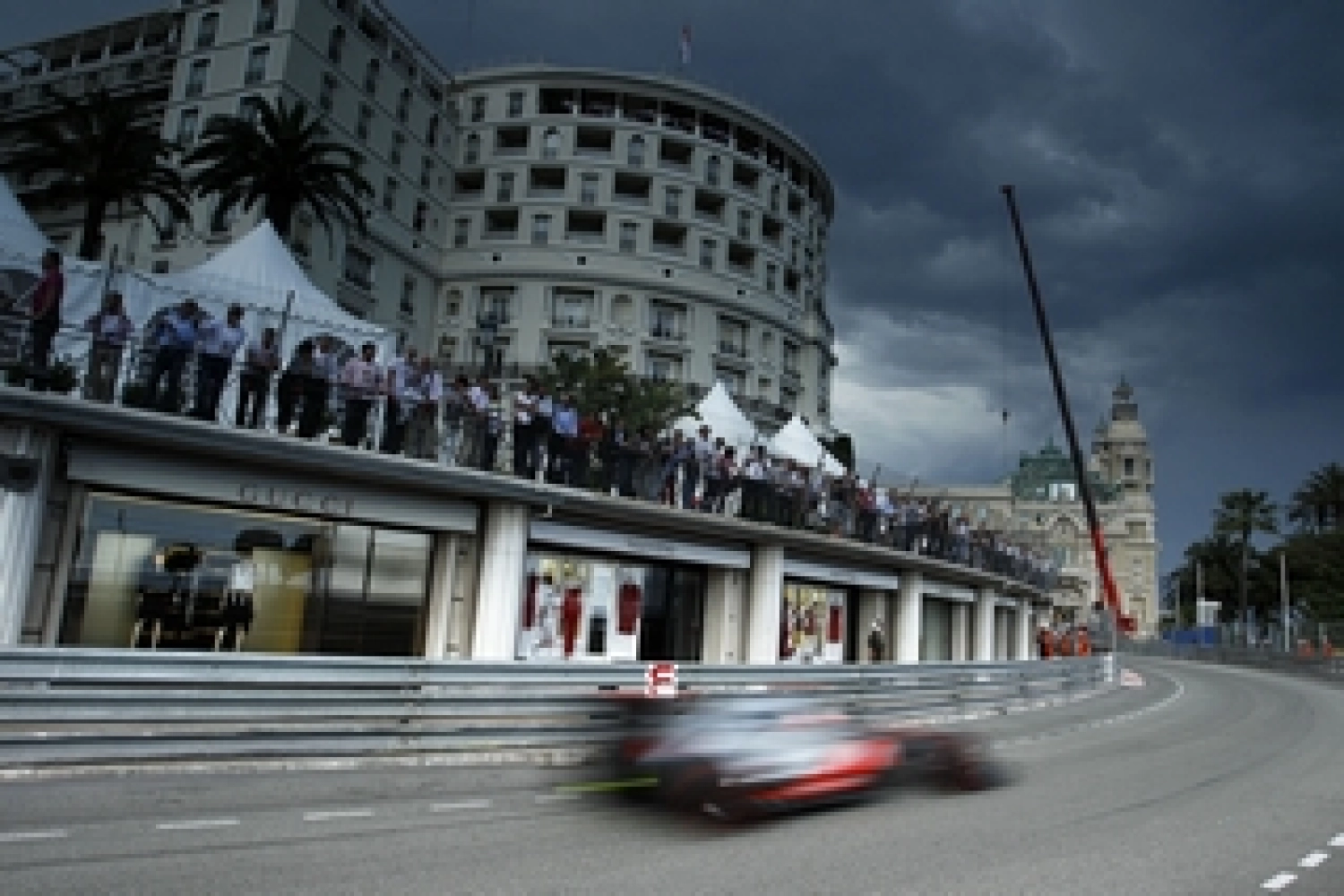
From the heights of the Monaco Rock, Ayrton Senna, the record holder for victories in the Principality, could have said: “Drivers, from the top of this Rock, six decades are watching you!” In 58 editions, no fewer than 32 drivers have triumphed in Monaco, adding to their achievements one of the most beautiful jewels of the global crown and writing, in turn, the thrilling history of a legendary event: “Monaco is the race everyone in F1 wants to win, and it’s not just a famous F1 race, it’s one of the biggest events of the year worldwide. For drivers, it’s a rather complicated race, both inside and outside the cars, but it’s a challenge that I really love, and racing in these streets is one of the good sides of being an F1 driver,” explains Heikki Kovalainen.
Quintuple winner in the Principality, Michael Schumacher acknowledges that a Formula One race in Monaco might seem anachronistic: “In a way, you could look at it with irony because for years we have fought for more safety on the circuits and at the same time we deliberately go to Monaco. But from my point of view, it is justified once a year, especially because it is a very fun circuit to drive. Every time you get there, you are eager to finally hit the track.” Mark Webber, for his part, recognizes that “it has become a bit easier than when [he] joined Formula 1, 10 years ago” but admits that “it remains a true test between man and track and with the car.”
Fernando Alonso, who could, in case of victory, become the only driver to have won in Monaco for three different teams, claims that more than the circuit, it is the atmosphere that makes the Monaco race so dear to the hearts of drivers: “I don’t think the track is particularly difficult or interesting compared to other street circuits like Singapore or fantastic tracks like Suzuka or Spa, where you really enjoy the lap. Here, it’s not so much about enjoying the lap in terms of driving, but the whole weekend is fantastic from the atmosphere, the crowd, the paddock perspective. We are closer to the fans here. […] Therefore, the track is the least important factor of the Monaco Grand Prix, with everything surrounding it being of greater importance. We all love to win here because of that, because winning the Monaco Grand Prix once in your life is something you’ll always remember.”
For Jenson Button, who claimed victory there with Brawn GP the year he was crowned champion, his win in Monaco remains one of his favorites in Formula One. Monte Carlo is a place where every driver wants to win, and succeeding here is so satisfying because you know you have conquered one of the most challenging circuits in motorsport. As for Kimi Räikkönen, although he refuses to rank circuits and claims Monaco holds no more significance than any other race, he nonetheless acknowledges that nothing compares to Monaco: There’s nothing better than succeeding here. Racing through the streets of Monte Carlo is truly different from anything else. It’s a challenge I look forward to every year. It’s very, very difficult to have a perfect weekend here. The Finn recalls that he only managed to put everything in order to win once: It’s the most beautiful feeling imaginable to win here. I rank my 2005 victory here as the most unforgettable. Winning again would be very special. And the Finn, who points out that overtaking remains difficult in Monaco, indicates consequently that to enjoy the race here, you have to be in the lead.
If he never made his mark in Monaco, Felipe Massa nonetheless retains a great memory of his pole position in 2008: « The lap I did in qualifying was really amazing, it’s something I will never forget. Finishing the race in Monaco is already a good result, but winning it allows you to enter history. »
At HRT, while Narain Karthikeyan acknowledges that street circuits traditionally aren’t his favorites, the Monaco race remains special in his eyes: « It’s not every day that we get to race in such a beautiful place and in such an atmosphere. It’s one of the toughest races because we’re so close to the rails that we can’t make the slightest mistake. » For some, including Felipe Massa, Monaco is even more special because they reside there, and have their friends and families there: « On normal days, you don’t feel like you’re on a track, except at Loews where the curbs are always in place. When you drive here, you’re always aware that you’re actually on an F1 circuit. You don’t think about that anywhere else. […] Filipinho knows that it’s here where I race, but he’s only interested when I can drive like in Mario Kart and collect bonuses! » Paul di Resta particularly appreciates being able to go home at night: « This is now where I live, and it’s interesting to see how much Monaco fills up when the race comes to town. It’s really nice to be able to go home every night, sleep in my bed, and enjoy my space. I also have a lot of family and friends around me who come to see the race. »
However, the Scot insists that the Monte-Carlo circuit demands a lot of confidence and commitment: There are some pleasant corners, like Casino where you arrive at 300 km/h and brake while turning for a blind corner. Then, there’s the slowest corner of the year, the hairpin, taken in first gear with maximum steering rotation. At the end of the lap near the swimming pool, you really feel the downforce and you need a single-seater that can climb the curbs and handle the bumps. It’s a real challenge for the drivers and engineers to have the perfect car.
For his part, after his terrible accident during the 2011 Grand Prix qualifiers, Sergio Pérez is eager to get back on the Monaco circuit: « This Grand Prix is the most special for me. I’ve wanted to compete in the Monaco F1 Grand Prix all my life and, of course, after what happened last year, I’m even more eager to be there. […] Of course, I also think back to the accident I had in Q3 last year. For me, it’s a key moment in my career: there’s a before and after the accident. I learned a lot from what I had to go through and I think it made me stronger. I really want to show what I can do in Monte Carlo. »
Moreover, the Mexican strongly believes that on this circuit, drivers can make a greater difference than on any other track. For Daniel Ricciardo, the Monaco circuit is primarily a challenge for drivers: In some way, that’s how racing should be. It really separates the great drivers from the good ones, and it’s something I appreciate. It’s not really about the car – the car doesn’t make a big difference on real city circuits like Monaco. If I were slow on a city circuit, I would know that it comes from me, and I would have to find a solution on my side. For me, everything is a bit clearer on a city circuit. Plus, it’s a lot of fun! I love racing between the walls – there’s even more adrenaline. Even if the speeds are slower, it feels twice as fast.
An opinion shared by Lewis Hamilton: « Monaco is a very special circuit. It is, alongside Silverstone, at the top of the circuits where I most want to perform well. Even though Monaco has the lowest average speed of all the circuits we visit in a season, you always feel incredibly fast. That’s because acceleration is so quick and the walls are so close: there really is no room for error. Apart from the runoff at Sainte-Dévote, and the small escape areas at Mirabeau and the harbor chicane, there is no room for a mistake. But when the stakes are at their highest, I just find that more exciting. »
If Vitaly Petrov recalls that the track itself is always a bit dirty at the start of the weekend and that makes it complicated to get the tires up to temperature, Nico Hülkenberg emphasizes that you have to grow with the car throughout the sessions to find the limits. But the Russian driver considers it tricky: If you make a mistake or have a bit of oversteer, you don’t even have a chance to correct, you’re in the wall. Therefore, the Monaco Grand Prix is also a mental challenge, as recent Spanish Grand Prix winner Pastor Maldonado insists: Monaco is a very demanding circuit for drivers from both a physical and mental point of view because you need constant concentration, but I really like this challenge. For Sebastian Vettel as well, the most recent winner in the Principality, concentration is crucial on this circuit: There is no room for errors. You have to surpass yourself and push the car to the limit to be fast, you have to attack as much as on other circuits, except there is no space. You can almost feel when you graze the rails and pass smoothly – but it’s a pleasant feeling. And Mark Webber adds: Physically, it’s quite easy, but mentally, you have to be very disciplined, and that’s the challenge Monaco offers.
Among the newcomers, for the most part, Monaco is not unknown territory, with GP2 and World Series by Renault taking place there during the Formula One Grand Prix: “I love racing there because I really like street circuits,” says Daniel Ricciardo. “I have really only raced on street circuits in Macau and Monaco, but I loved them from the first moment I raced there. Racing on such bumpy and slippery roads with the walls so close is fantastic. There are so many things a driver has to deal with. There is no room for error.” Charles Pic, however, believes that his experience in GP2 does not make his task any easier: “Monaco is special, and it’s one of the races I was most looking forward to for my first season. Nothing prepares you for such a challenge, despite my experience in GP2 here, and I can’t wait to race there for the first time. The track is really unforgiving, so I hope to leave with the feeling of having had a good weekend.”
For the tricolore drivers, in the absence of the French Grand Prix, the Monaco event could serve as a home race: « There will certainly be many French supporters and I am looking forward to seeing them. The event is, in any case, special in itself. And the atmosphere is pretty crazy! For a driver, it’s essential to stay calm, relaxed, and try to do your job. This circuit doesn’t allow for the slightest mistake. You have to respect it, that’s the key here. » But Jean-Eric Vergne will not feel like it’s a home race: « We obviously don’t have a French Grand Prix at the moment and some say that Monaco is like a home Grand Prix for French drivers. I don’t think this way; it’s not my home race. In fact, if I had to choose one, it would be Spa. »
But the Monaco Grand Prix remains above all unpredictable, as Romain Grosjean explains: « Monaco is a circuit for specialists, and it’s difficult to say whether a car will perform well or not. The straights are bumpy and the surface offers little grip. All this means you never know what to expect. On a traditional circuit, you know a little more. » Thus, for Kamui Kobayashi, the key is to avoid the pitfalls: « In Monaco, many things can happen, so it’s important to stay out of trouble and see the finish line. » Pedro de la Rosa gives us the key ingredients, according to him, to succeed in Monaco: « The only trick is to accumulate kilometers and not change the car settings too much because you can find more in the driver than in the car. We must try to do as many laps as possible on Thursday to build confidence for qualifying because it’s more important than anything in Monaco. Another major difficulty on this circuit is the traffic: it’s vital to complete a clear lap and exploit it to the maximum. In the race, the most important thing is to manage your strategy well, and there is more than likely to be a safety car, so luck can also come into play. »
Nico Rosberg also thinks that the 2012 vintage could be a great one: « With five different winning teams this year, at least ten drivers could win in Monaco, so it could be one of the most interesting races here in years. »
Some chronological landmarks:
1994: After starting from pole position, Michael Schumacher (Benetton) claims his first victory on the streets of Monaco, the first Monaco Grand Prix held since the death of Ayrton Senna, six-time winner in the Principality. Additionally, during Free Practice, the German Karl Wendlinger (Sauber) suffers a crash that leaves him in a coma for several weeks.
1996: Olivier Panis (Ligier) secures his one and only Grand Prix victory at the end of a race that saw only three cars cross the finish line. Winner in 1995, Michael Schumacher (Ferrari) retires on the first lap after going off track.
1997: Michael Schumacher (Ferrari) wins the event for the third time. Stewart Grand Prix steps onto the podium for the first time and will replicate this achievement in 2001 under the name Jaguar and in 2006 under the name Red Bull.
1998: McLaren returns to victory in Monaco thanks to Mika Hakkinen.
1999: Michael Schumacher (Ferrari) wins his 4th victory in Monaco.
2002: Michael Schumacher (Ferrari) wins his 5th and, to date, last victory in Monaco, thus matching the performance of Graham Hill, five-time winner in Monte Carlo.
2003: Juan Pablo Montoya claims his second victory for the Williams team, the last victory for a driver from the Grove team, to date, in Monaco.
2005: Kimi Räikkönen (McLaren) scores his only victory in Monaco to date. Meanwhile, Mark Webber (Williams) climbs onto a Formula One podium for the first time.
2006: After the controversy of the Rascasse incident, caused by Michael Schumacher, and the demotion of the German driver, Fernando Alonso starts from pole position and wins the first of his two victories in Monaco.
2007: Now with McLaren, Fernando Alonso wins once again in the streets of Monte-Carlo with Lewis Hamilton on his heels. By stating after the race that he is just a beginner and the team’s number 2 driver, the young Briton would ignite the English press and trigger an investigation, without consequences, by the FIA, which wanted to ensure no team orders had taken place. The Stevenage native would, in fact, win the following year.
2009: Jenson Button (Brawn GP) wins and parks his car in Parc Fermé instead of parking it, as is customary, at the foot of the podium. After 1h40 of racing, the Briton showcases his triathlete qualities by running to the podium to receive the coveted trophy sought after by many drivers.
**2010:** After leading the race from start to finish, Mark Webber (Red Bull) wins in Monaco for the first time. Behind him, Michael Schumacher (Mercedes) is penalized for overtaking Fernando Alonso (Ferrari) as the race ended under the safety car.
2011: Sebastian Vettel (Red Bull) wins in Monaco after starting from pole position. On the podium, he is flanked by two former winners of the event: Fernando Alonso (Ferrari) and Jenson Button (McLaren). The battle for victory among the three was notably disrupted by a pile-up on the circuit, which, causing a red flag, had nullified everyone’s strategies.