Bahrain: A Moral Dilemma for Formula 1
While the situation in Bahrain does not seem to be calming down, Damon Hill believes that Formula One is flirting with the limit and calls on the FIA to reconsider the viability of the Grand Prix, scheduled for less than two weeks from now. The International Automobile Federation, for its part, assures that it is closely monitoring the situation every day.

A staunch opponent of the Bahrain Grand Prix in 2011, when the country was hit by a protest movement violently suppressed by the ruling power, Damon Hill was nonetheless optimistic about the Grand Prix’s 2012 edition, after having visited the small Gulf kingdom in person: “I don’t like seeing people being shot at and brutalized. I was frustrated that, last year, Formula One didn’t voice its opinion on what was happening. [Since then,] I’ve listened to many people there, including eyewitnesses. I believe they are making changes for the better,” Hill explained in the columns of the Times, last January. “There’s no doubt that they have problems, but all countries do: we had riots in the UK not that long ago.”
Bahrain had also sent signs of appeasement by ordering an investigative report on the events of February 2011, whose conclusions, damning for the law enforcement agencies, were made public in the presence of the King. Furthermore, after being dismissed for their participation in the protest movement, the employees of the Bahrain International Circuit were reinstated in their positions, leading the world of Formula One, with Damon Hill at the forefront, to believe that the 2012 Grand Prix could be placed under the sign of national reconciliation: « This time, Formula 1 can go to Bahrain with a clear conscience and not just as a tool of propaganda » thought the 1996 world champion at the time.
However, recently, the situation in the Bahraini Kingdom seems hardly conducive to hosting an international sporting event. On March 31, a Bahraini “citizen journalist,” Ahmed Ismail Hussain, was shot dead while filming law enforcement using tear gas and rubber bullets to disperse a protest in the village of Samabad. According to the Bahrain Center for Human Rights, the 22-year-old was allegedly the victim of armed forces firing live ammunition from unmarked vehicles. In 2011, Reporters Without Borders ranked Bahrain as one of the ten most dangerous places for journalists. On February 14, during the first anniversary of the protests, Mazen Mahdi and Muhammad Hamad, photographers working for the DPA agency and Reuters respectively, were targeted by tear gas, as was Simeon Kerr, a correspondent for the Financial Times, while they covered the police assault on a convoy of protesters heading to the infamous Pearl Square.
Thus, Damon Hill believes, in the columns of the Telegraph, that things are now different: « The protests continue and may have become even more determined and calculated. These are worrying circumstances. What must take precedence above all is the potential human cost if the race takes place. […] The opinion I formulated after my visit last year was based on my understanding of several factors: the significant economic importance of the Bahrain Grand Prix, the condemnation, in an investigation report, of the actions of the police and security forces, while both parties were supposed to engage in meaningful dialogue to resolve the issues peacefully. Under these conditions, one could imagine that the Grand Prix could have been of great help in aiding Bahrain’s recovery. However, with less than three weeks before we go there, the conditions do not seem to have improved judging by reports from newspapers in Europe, social media, and Al Jazeera television.
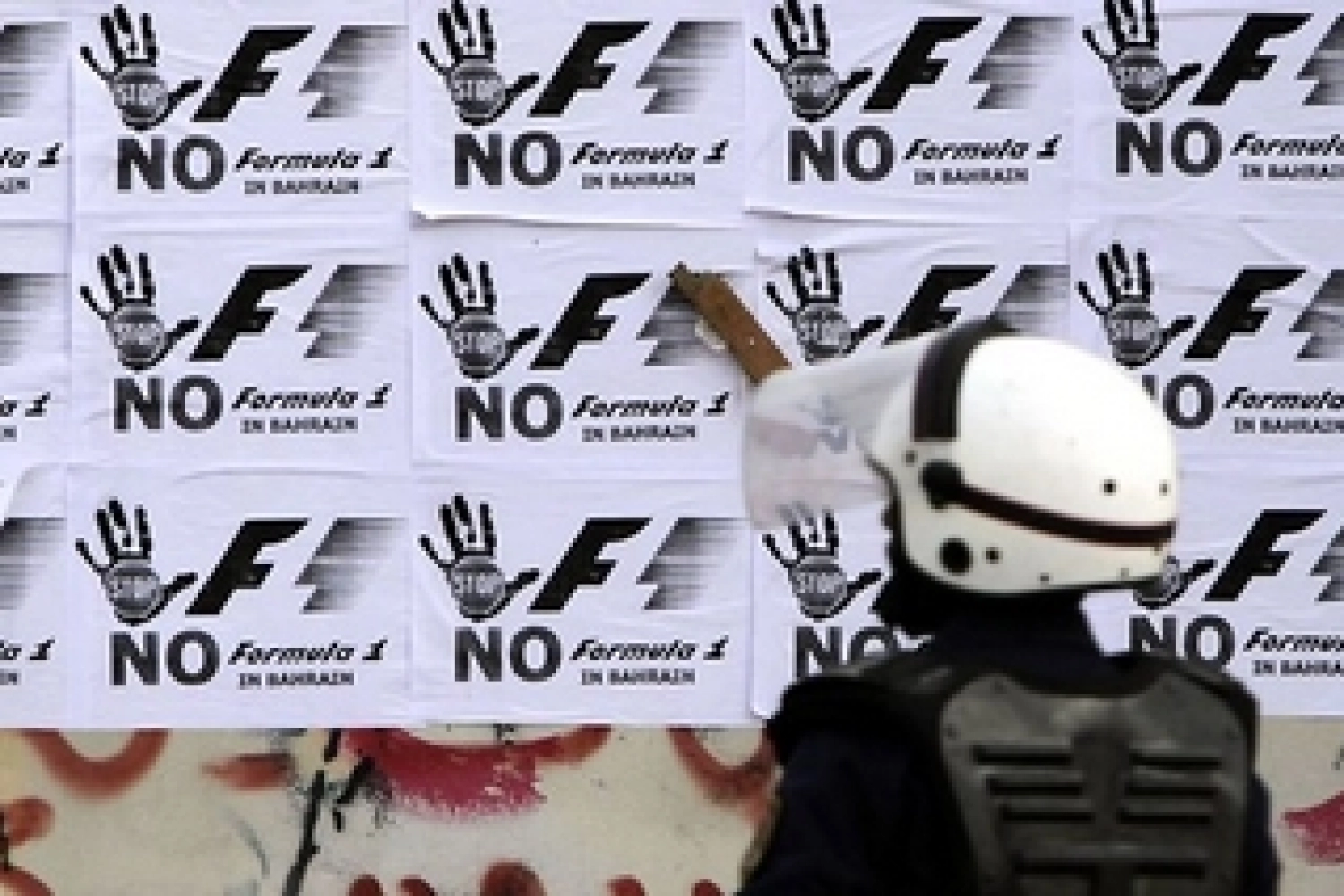
Aware of the stakes, the protest movement no longer hesitates to threaten the Grand Prix, with the country’s walls covered in graffiti calling for a boycott of the Grand Prix. On Twitter, protesters are mobilizing against the organization of the Grand Prix with hashtags #BloodyF1 and #NoF1, while a video circulates on YouTube showing a young demonstrator, dressed in a white shroud and a black hood, urging Formula 1 to reconsider the legitimacy of the Grand Prix: « We oppose the holding of a sporting event that denies the sacrifice of our children and ignores our suffering and wounds. […] Do not tarnish the reputation of a respected sport with the blood of Bahrain’s victims. »
Damon Hill fears that the Grand Prix might be used as a pretext to strengthen repressive measures: “It would be a bad scenario, negative for F1, to see martial law strengthened to allow the race to take place. This is not the image this sport should project. Today, we must acknowledge that the race could create more problems than it solves,” states the Briton. “The recent meeting to gather support for the race, with the notion of it being a unifying event, was troubled by attempts to portray the protests in Bahrain as the result of a bad press and a youth issue. […] I’m simply saying we must exercise caution. I hope the FIA fully considers what this entails and that the situation in Bahrain is not what they are being sold, namely a bunch of thugs throwing Molotov cocktails, because that is a gross oversimplification. […] A hundred thousand people do not risk their lives to protest for no reason.”
After the statements by Damon Hill, a spokesperson for the FIA indicated to the agency Reuters that the FIA is in constant contact with the highest authorities, the main European embassies, and of course with the promoters of the Bahrain International Circuit: The FIA is the guarantor of the safety of the Grand Prix and relies, as it does for each country, on the guarantees provided by the local authorities. In this regard, the highest authorities in Bahrain have assured us repeatedly that all security issues are under control.
Richard Burden, a British parliamentarian, has no doubt that the Bahraini authorities will move heaven and earth to minimize the risks for the teams, but he also fears that the long-term damage to the reputation of Formula One and motorsports in general could be considerable. The Labour MP believes Damon Hill is right to call on the governing bodies to exercise caution: I say this as a motorsport enthusiast and as a parliamentarian with a keen interest in the Middle East. Since February 2011, 45 people have died on the streets of Bahrain. The latest victim was killed by live ammunition just last week. Hundreds of people gathered at the cemetery near his house on the outskirts of Manama, the capital. Reports indicate that the police fired tear gas and stun grenades into the crowd, causing panic in the streets. Such scenes are unfortunately not uncommon. The situation in Bahrain does not seem as dire as in Syria, and Formula One teams race in other countries where human rights are violated, but that does not mean that F1 should accept presenting to the outside world an image of comforting normality on the Sakhir circuit when things are very different just a few kilometers away.
For his part, Damon Hill insists that Formula 1’s intentions should be clear, even though he himself doubts them: If we have to go, we will go, but there is still a lot of suffering, pain, and tension in Bahrain. It would be better for Formula 1 to clearly state that it understands this and that it simply wishes the best for all of Bahrain or any country it visits. I think F1 flirts a lot with the limit. But there is an even more troubling thought: “Isn’t Formula One walking a tightrope purely for financial reasons while young people put their lives at risk to protest against this event?”