The return of wishbone suspensions
In 2009, Red Bull brought back into vogue a technology that had not been used for several years in F1, the pull-rod suspension. Since then, several teams have decided to follow the same path as the Milton Keynes team by implementing rear pull-rod suspensions, but Ferrari went even further with the F2012 by also using front pull-rod suspensions.

For several seasons, suspensions have been evolving in Formula 1 following the influence of Adrian Newey and Red Bull. The rear suspensions, which until 2008 were mostly pushrod suspensions, are now becoming pull-rod suspensions. A look at a change that’s not very visible to fans but important for F1 teams.
Before delving into why this technology is making a comeback in Formula 1, here’s a brief practical lesson to explain what a pull-rod suspension is and how it differs from a push-rod suspension. Pull-rod suspensions were introduced in Formula 1 in the 1970s by engineer Gordon Murray, who was working for the Brabham team at the time.
When a single-seater car is running, forces are exerted, particularly at the wheels, which are the elements that connect the car to the ground. Push-rod suspensions allow the forces experienced to be transmitted to the spring, located inside the single-seater, while pull-rod suspensions eliminate these forces by pulling the shock absorber, also located inside the single-seater.
If pull-rod suspensions were brought back into vogue by Adrian Newey with the RB5 in 2009, it’s because they take up less space, especially at the rear of the car where the gearbox is located, which is a fairly bulky element. They are also lighter, but beyond saving space and weight, the pull-rod suspensions have a major advantage that explains their resurgence: they allow for a lower center of gravity in the cars, which improves airflow and therefore the aerodynamic downforce of the vehicle.
In 2009 and 2010, Red Bull was the only team to use pull-rod rear suspensions on its cars, and likely due to its success, several other teams decided to adopt this system as well. In 2011, the McLaren, Mercedes GP, Lotus Renault, Williams, and Force India teams, like Red Bull, had pull-rod rear suspensions.
In 2012, Ferrari also decided to implement this technology, just like Sauber, which has the Ferrari gearbox and engine—this new configuration on the C31 was notably tested by Kamui Kobayashi in Jerez.
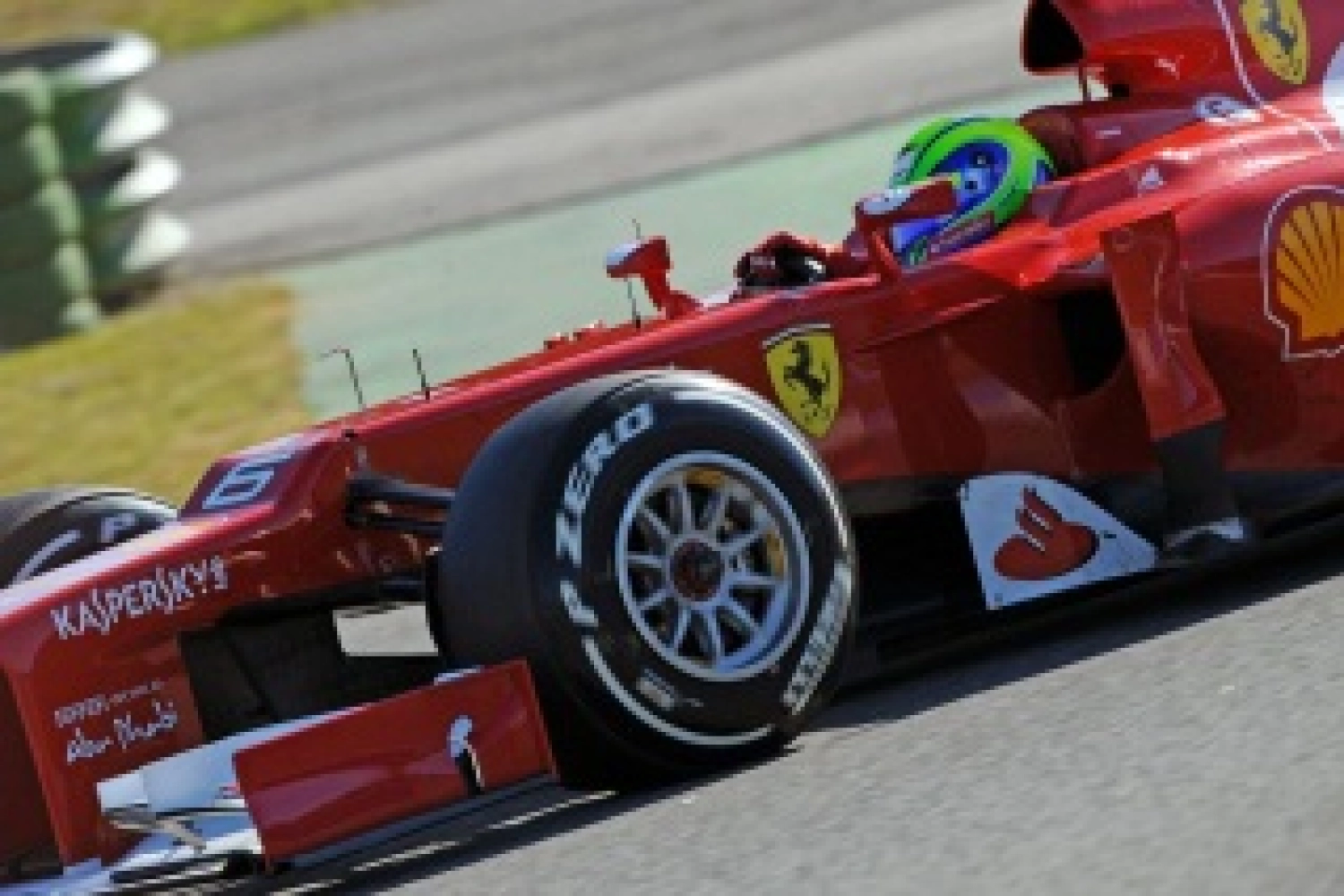
Ferrari promised at the end of 2011 a more aggressive 2012 single-seater and that’s the case because Ferrari has pushed the concept of pull-rod suspensions even further with its F2012. Marc Gené, one of the test drivers for the Maranello team, revealed that the Scuderia decided to implement front pull-rod suspensions, something not seen in Formula 1 since 2001 with the Minardi PS-01 – the Arrows team also used the same system during the 2000 season.
« The system aims to lower the center of gravity and improve the entry and passage of air from the front to the rear (of the single-seater) to enhance downforce. The last time this was seen at the front was in 2001 on Fernando Alonso’s Minardi, » Marc Gené told the Spanish newspaper El Mundo.
As you can see in the image below, the position of the suspensions is very different between the Ferrari – equipped with pull-rod suspension – and the McLaren, equipped with push-rod suspension. Just a few years ago, implementing front pull-rod suspensions seemed almost impossible with the front wings used due to their high position relative to the wheels. But following the introduction of a new rule by the FIA requiring teams to have a lower front wing, Ferrari seems to have succeeded in finding an interesting solution.

Ferrari also managed to integrate this system without making too many changes in the cockpit, as Fernando Alonso explained in Jerez, quoted by Marca: «It hasn’t changed our driving position. We are exactly in the same spot in the cockpit. Felipe and I are rather short and we have the pedals close to us, so the new suspension doesn’t disturb us at all.»
For the moment, after only four days of testing, it’s difficult to know if the Italian team made the right choice and if this choice will prove successful. What is certain is that the Italian team has taken a gamble, and that is commendable, because in recent years they have been labeled as cautious, following the trend rather than setting it.