Pirelli in the Paddock
Invited by Pirelli to experience the Italian Grand Prix from the paddock, casinoenligne.uk.com invites you to discover behind the scenes of the Italian manufacturer.

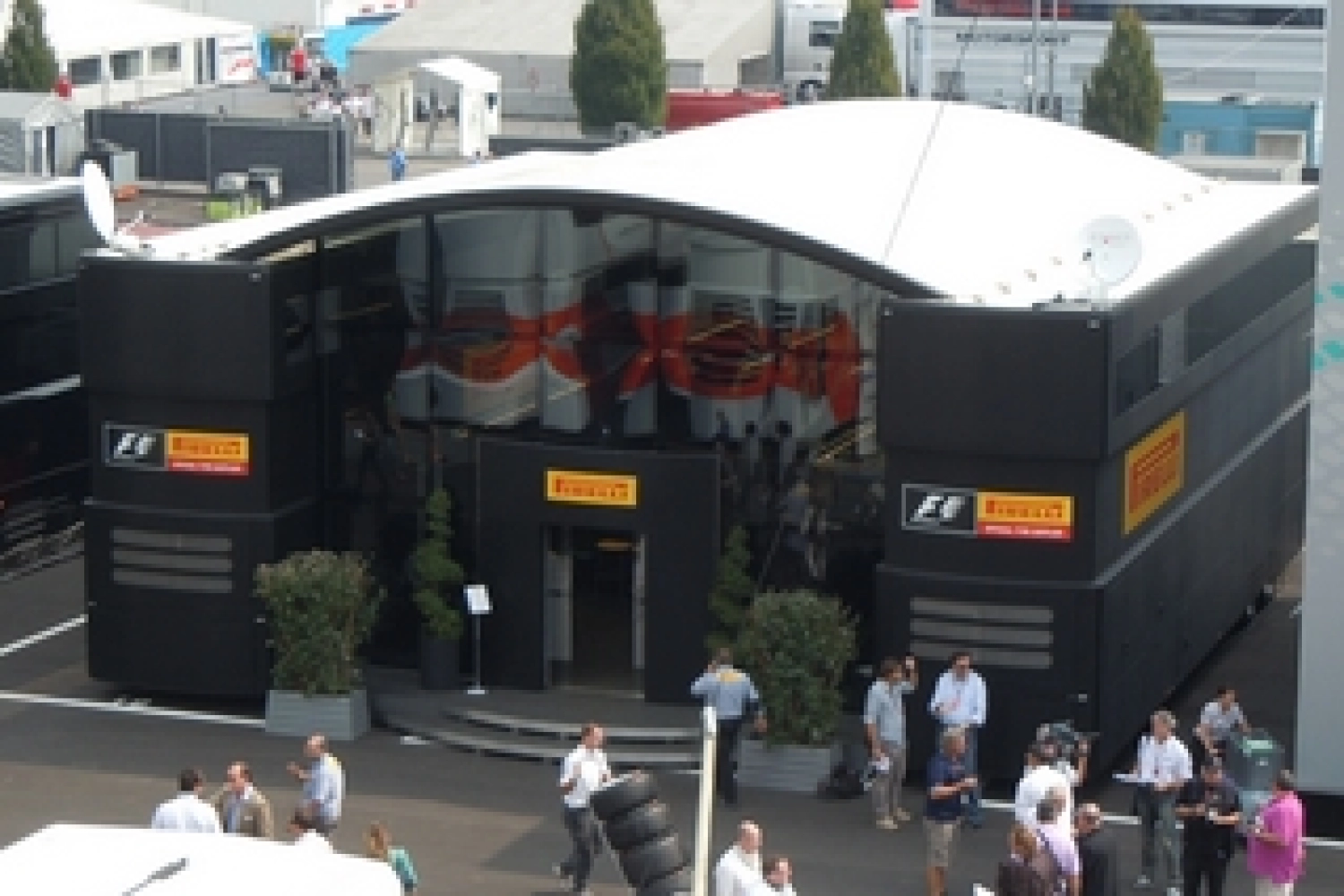
This is an unpretentious motorhome that welcomes us in the Monza paddock. Located roughly at its center, the Pirelli motorhome consists of two matte black buses, connected by a spacious and elegant veranda, nestled between the flagship vessels of Lotus Renault GP—whose glossy black only enhances the elegance of the Italian manufacturer’s motorhome—and the Mercedes team. At a time when it takes three days to construct the McLaren motorhome, Pirelli’s only takes one day to set up, a reminder of a time, not so long ago, when motorhomes were still welcoming, human-sized places open to the paddock.
Far from reaching the ostentation of some of its neighbors, the Pirelli motorhome still has enough to make some teams in the paddock blush. Large bay windows—without the reflective effect that gives a forbidden feel like at McLaren—and an automatic door, are all invitations to visit this small but comfortable space dedicated to work and rest. Upon entering, a reception lounge, consisting of armchairs surrounding a few low tables, allows visitors to quickly exchange a few words, catch up on the latest news, available at will, and for regulars, access the work and private spaces nestled on the upper floor of each bus. But the Pirelli motorhome, under its vast veranda, primarily serves as a gathering point for those working for the Italian manufacturer on the circuits, offering a dining space where they can enjoy the culinary delights of Fabrizio, the in-house chef.
In the paddock, no fewer than 50 people work on behalf of Pirelli: 18 “assemblers” who handle the assembly and disassembly of tires, and 28 engineers, 4 of whom are in charge of research and 12 are assigned to each of the teams. Added to this is, of course, the entire hierarchical chain, from Paul Hembery, director of Pirelli Motorsport, to Mario Isola, race manager, responsible for the daily operations at each GP3, GP2, and Formula One weekend, not forgetting, of course, the press officer, Alexandra Schieren.
But the true nerve center of Pirelli is located a few dozen meters further, behind the Red Bull motorhome, at the entrance of the second paddock that hosts the other series on the weekend’s schedule. It is here, indeed, sheltered from the tumult or almost, that the fitters handle the approximately 1800 tires brought to each Grand Prix by Pirelli, which is a small matter of 7 trucks. They receive the rims, owned by the teams, which they fit with tires that have already traveled several thousand kilometers.
It is only a few nautical miles from Monza that the Pirelli F1 tires were born, right in the heart of Bicocca, the famous district on the outskirts of Milan, whose name is invariably associated with the Italian manufacturer that established its headquarters there. No fewer than one hundred and fifty engineers, both physicists and chemists, are dedicated exclusively to developing the structure and compounds that make up the Pirelli Formula One tires. The first prototypes were subsequently designed directly in the Formula One department of the Izmit facility in Turkey, where nearly 200 fitters, technicians, and engineers work. Back in Milan, all these tires underwent a series of increasingly demanding tests before being subjected to the verdict of the track.
In total, over the course of a season, Pirelli must produce approximately 50,000 tires, each made up of 100 elements and 18 different structural components. On the production line specifically dedicated to Formula One in Izmit, the carcasses and treads are produced separately and then assembled before vulcanization – that is, the baking – of the tire. At the end of a one-week production cycle and after passing all necessary quality checks, both by eye and X-ray, each tire is given a barcode, allowing for true traceability throughout the weekend.
Once allocated by the FIA through a random draw – thanks to these barcodes – to avoid any suspicion of favoritism, the tires are then mounted on the rims, which are the property of the teams, and live their very ephemeral but intense life as Formula One tires.
But of course, at a time when Formula One must face new ecological demands, the question arises about the second life of Pirelli tires. After use, and gradually throughout the weekend, teams must return their tires to the Italian manufacturer. Fixed directly on the rim, even unused tires are destined for destruction, a waste against which Pirelli is trying to find solutions, although facing resistance from teams regarding change.
The fact remains that after each Grand Prix, the 1,800 tires brought by Pirelli make their final journey to England, where they are recycled, as Paul Hembery explained to casinoenligne.uk.com: « The environment is very high on our list of priorities, so we are committed to disposing of all our tires in an environmentally friendly way. All the tires are sent back to our facilities in Great Britain after each Grand Prix, where they are shredded into small pieces. These pieces are then burned at extremely high temperatures and converted into fuel for cement plants. Because the temperatures are very high, no toxic smoke is emitted, and what remains is very refined, without toxic elements. We have actually been using this technology in Italy since 2002, but it makes even more sense now that we are involved in Formula One. »