Crime, a problem for drivers at Interlagos?
After the attack Jenson Button narrowly escaped in 2010, the Briton returns with peace of mind to Interlagos as Brazil's reputation for insecurity seems to be fading.

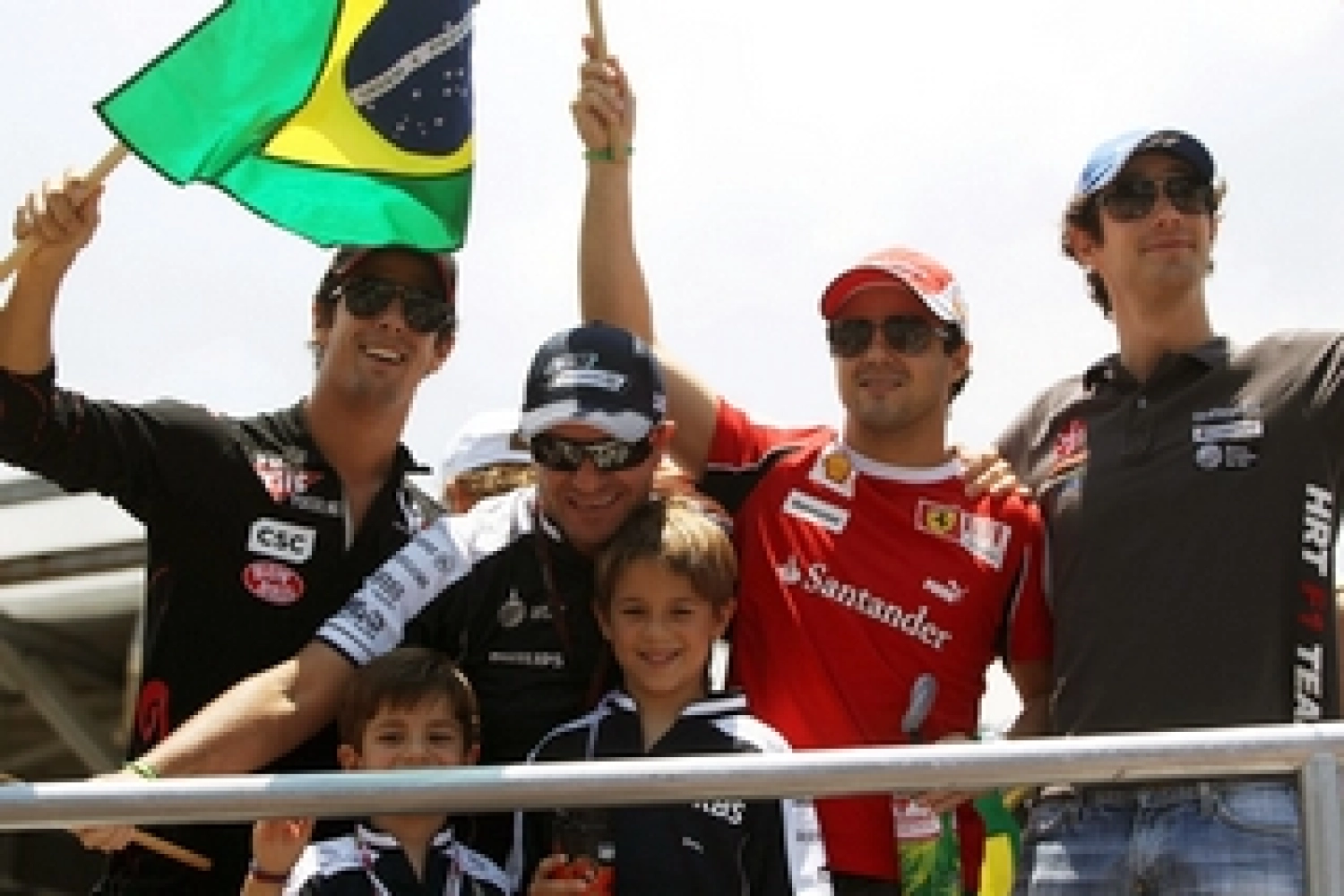
This week, by returning to São Paulo, Jenson Button revisits not only the place that must hold the strongest memory of his career, having been crowned champion after the Brazilian Grand Prix in 2009, but also the scene of a less pleasant memory. Indeed, on November 6, 2010, as he was leaving the circuit after the qualifiers, the British driver’s car narrowly escaped an attack by six armed men, thanks to the quick-wittedness of the vehicle’s driver who, sensing the danger, forced his way through the traffic. This attack, the most publicized because it involved a top championship driver, was not the only violent incident that marred this Grand Prix, as Sauber engineers experienced a similar ordeal, with the difference being that, this time, the attackers succeeded in their heist without the assault resulting in injuries.
Nestled in the heart of São Paulo’s popular neighborhoods, the Interlagos circuit and the splendor surrounding the organization of a Formula 1 Grand Prix starkly contrast with poverty that often rhymes with violence and crime, a scourge and a reputation that Brazil has suffered from for decades. And yet, most studies on crime tend to show that it has been significantly decreasing since the 1990s. For example, the homicide rate in São Paulo decreased from 64 per 100,000 people in the mid-1990s to 39 per 100,000 people in 2010. In the Jardim Ângela neighborhood, one of the poorest in the Brazilian megacity, this rate fell from 112 homicide victims per 100,000 people in 1995 to 33 in 2006.
According to *The Economist*, this change is due to a true awareness of the urgency of the situation, starting with a law passed in 2003 that restricted gun ownership—some statistics suggest there is one gun for every 75 inhabitants—accompanied by an amnesty and gun buyback program, a policy that will soon be renewed. The modernization of available resources for the police has also played a significant role in solving crimes and offenses, thus reducing crime: after representing only 8% of the solved crimes in Brazil, the province of São Paulo now accounts for nearly 70%. Added to this is an educational policy and, more broadly, the empowerment of the population, while demographic changes naturally contribute to reducing crime, especially among young people. However, the decrease in crime in certain neighborhoods of São Paulo must also be associated with the monopoly position obtained by a single gang, called *Primeiro Comando da Capital*, which, as a result, no longer needs to eliminate its rivals and against which the police can further concentrate their efforts.
Although considered and in full positive evolution, it does not prevent crime from remaining a major issue in Brazil, especially with upcoming events such as the FIFA World Cup to be held there in 2014 or the Summer Olympics in Rio de Janeiro in 2016. Regarding Formula One, the authorities have learned from last season’s problems by increasing security around the drivers. As for Jenson Button, he returns to Brazil without any fear for his safety: « It has happened so many times with the mechanics and engineers that, in the end, it had to happen to a driver. I don’t think they wanted anything other than our luggage, but we are more secure today. I think all the drivers you see will have a police escort and they should have one, but we also need to think about all the other people involved in Formula One who don’t have a police escort. »
The 2009 world champion prefers to focus on the positive: « I love racing in São Paulo, there is a special atmosphere, even when your teammate is Brazilian and you are fighting for the world championship. I always love coming here because the people are so passionate and there is such history on this track. It’s a shame that things happen outside the circuit, but I think it simply shows the social divide that splits the country. »
The future of Interlagos does not suffer from these problems. « We are not going to cancel a great race because of a few individuals causing trouble, » assures Bernie Ecclestone in the British press.