Australia – Race: Strategy Summary
casinoenligne.uk.com invites you to discover, in graphic form, the strategies employed by each team during the 2012 Australian Grand Prix.

The tires with 2012 technical specifications lived up to all their promises, offering a wide variety of strategies thanks to a reduction in the performance gap between this year’s new compounds. The new versions of the soft P Zero Yellow and medium P Zero White tires were designated for the Australian Grand Prix, but very little time was spent on a dry track before the start of the race; only Free Practice 3 was run without rain.
The leaders adopted a two-stop strategy during the race, as they did last year. However, the pace of the mediums compared to the softs was only five-tenths of a second per lap this time. This difference led drivers to use the tires differently, with some preferring to do two stints on softs, while others opted for the gamble of two stints on mediums. Sauber driver Sergio Perez once again stood out by being the only one to make just one stop, starting on mediums and switching to softs on lap 24, allowing him to secure eighth position.
One of the turning points of the race occurred on the 36th lap, when Sebastian Vettel took over the second position with his Red Bull at the expense of Lewis Hamilton’s McLaren, which had just pitted. Until then, McLaren’s tire strategy had worked perfectly, with the team choosing to pit both of their cars on the same lap for their second stop, just before the safety car was deployed. When the safety car left the track with only 16 laps remaining, all the drivers except for those in Toro Rosso were on the medium P Zero White tires.
Upon the restart, leader Jenson Button managed to capitalize on the quick warm-up of the medium compound—despite the cool afternoon conditions—to break away from the pack by a second in the first sector, before clinching the final victory in Australia. Vettel, in second place, had adopted a completely different strategy, using soft tires during his middle stint. Last season, the German won the Grand Prix with a 22-second lead. This year, Button secured victory with just over two seconds.
The leading quartet was within five seconds during the last ten laps of the race, with the fight for the final podium spot continuing until the last lap. A first long stint allowed former World Champion Kimi Räikkönen to climb up to the points, finishing in seventh place in the final lap, after starting from 18th position.
The best lap was set with the medium P Zero White compound by Jenson Button, who achieved the thirteenth victory of his career. It was Sergio Perez who completed the longest stint of the race (33 laps) with the medium compound; the furthest distance on the soft compound was logged by Mercedes driver Nico Rosberg.
Paul Hembery, Pirelli Motorsport Director: The Australian Grand Prix clearly met our expectations, and we achieved our objectives by offering a variety of strategies thanks to the reduced performance gap between the compounds, while extending the peak performance window. One interesting aspect is that pit stops were made not because of tire wear but due to degradation, confirming what we wanted to implement in terms of strategy. We also saw greater use of the medium tire compared to the soft, unlike last year. Despite this variety of strategies, there were very tight battles throughout the field, culminating in a dramatic final lap during which a driver crashed and the eighth, ninth, and tenth places finished almost together! Tire wear and degradation were about 0.1 per lap on the soft compound. The leading drivers thus decided to pit twice despite the fast pace at the front. Congratulations to Jenson Button and McLaren for their distinguished victory and to Mark Webber, achieving his best result at home.
From the official statement released by Pirelli

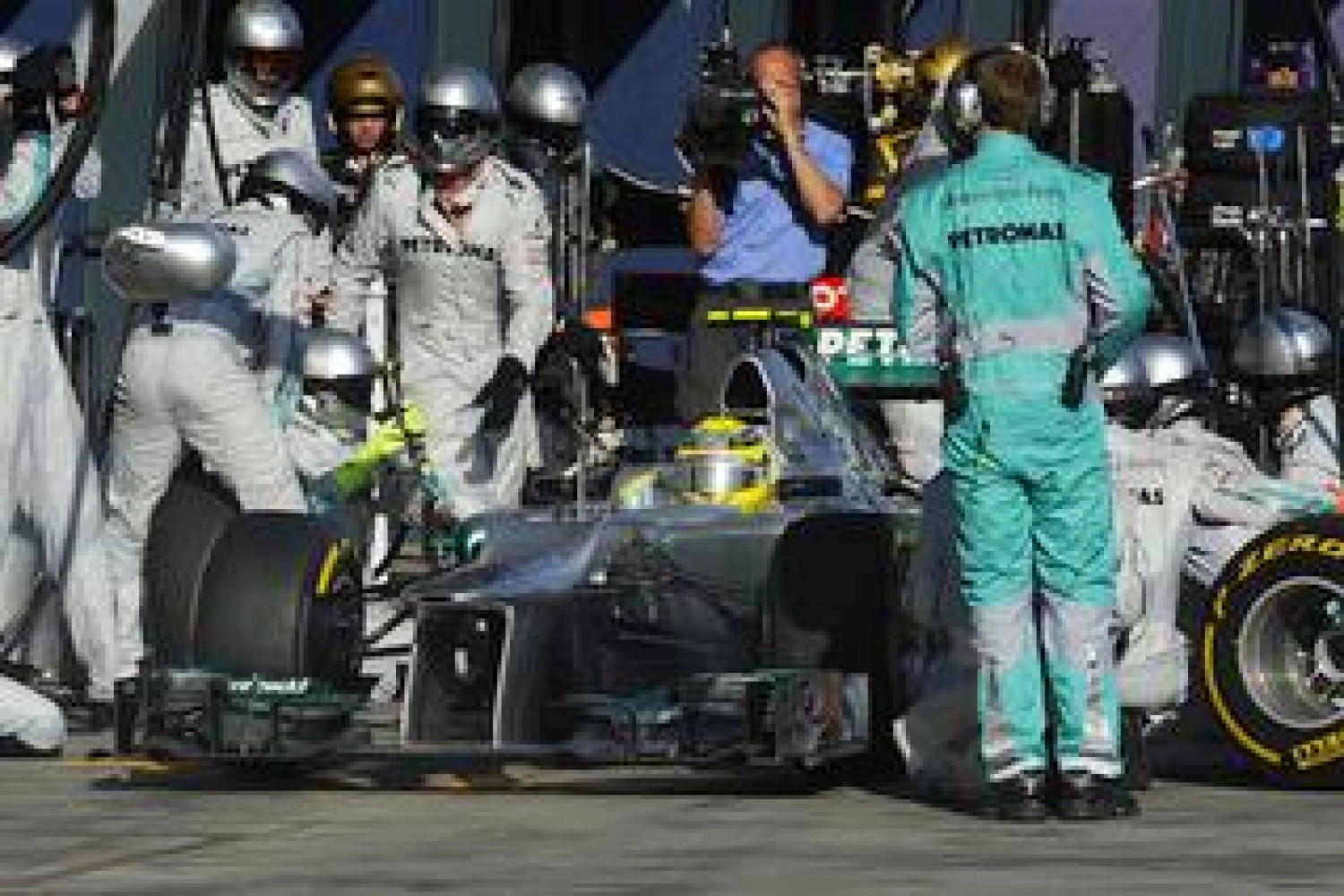
Summary of pit stops during the 2012 Australian Grand Prix:
| Drivers | Teams | Stops | Fastest | Average | Total | |
| 1 | Fernando Alonso | Ferrari | 2 | 21.910 | 21.973 | 43.945 |
| 2 | Felipe Massa | Ferrari | 3 | 22.103 | 22.315 | 1:06.944 |
| 3 | Jenson Button | McLaren | 2 | 22.837 | 23.056 | 46.112 |
| 4 | Lewis Hamilton | McLaren | 2 | 22.862 | 23.163 | 46.326 |
| 5 | Mark Webber | Red Bull | 2 | 22.915 | 23.109 | 46.217 |
| 6 | Nico Rosberg | Mercedes | 2 | 23.017 | 23.110 | 46.220 |
| 7 | Pastor Maldonado | Williams | 2 | 23.166 | 23.297 | 46.593 |
| 8 | Jean-Eric Vergne | Toro Rosso | 2 | 23.203 | 23.386 | 46.772 |
| 9 | Daniel Ricciardo | Toro Rosso | 3 | 23.257 | 26.641 | 1:19.924 |
| 10 | Kimi Räikkönen | Lotus | 2 | 23.310 | 24.096 | 48.191 |
| 11 | Bruno Senna | Williams | 3 | 23.777 | 26.421 | 1:19.264 |
| 12 | Sergio Perez | Sauber | 1 | 23.882 | 23.882 | 23.882 |
| 13 | Sebastian Vettel | Red Bull | 2 | 24.131 | 24.194 | 48.387 |
| 14 | Kamui Kobayashi | Sauber | 2 | 24.162 | 24.754 | 49.508 |
| 15 | Heïkki Kovalainen | Caterham | 3 | 24.397 | 25.955 | 1:17.865 |
| 16 | Vitaly Petrov | Caterham | 1 | 24.579 | 24.579 | 24.579 |
| 17 | Paul di Resta | Force India | 2 | 24.579 | 24.756 | 49.512 |
| 18 | Timo Glock | Marussia | 2 | 25.046 | 25.684 | 51.368 |
| 19 | Charles Pic | Marussia | 2 | 25.303 | 37.144 | 1:14.287 |
To get a better understanding of this chart, you can use the FIA’s lap-by-lap synthesis by clicking here.