Malaysia: Figures and Technical Data
Overview of the technical constraints imposed by the Sepang circuit on the chassis, engine, and tires of a Formula One car.

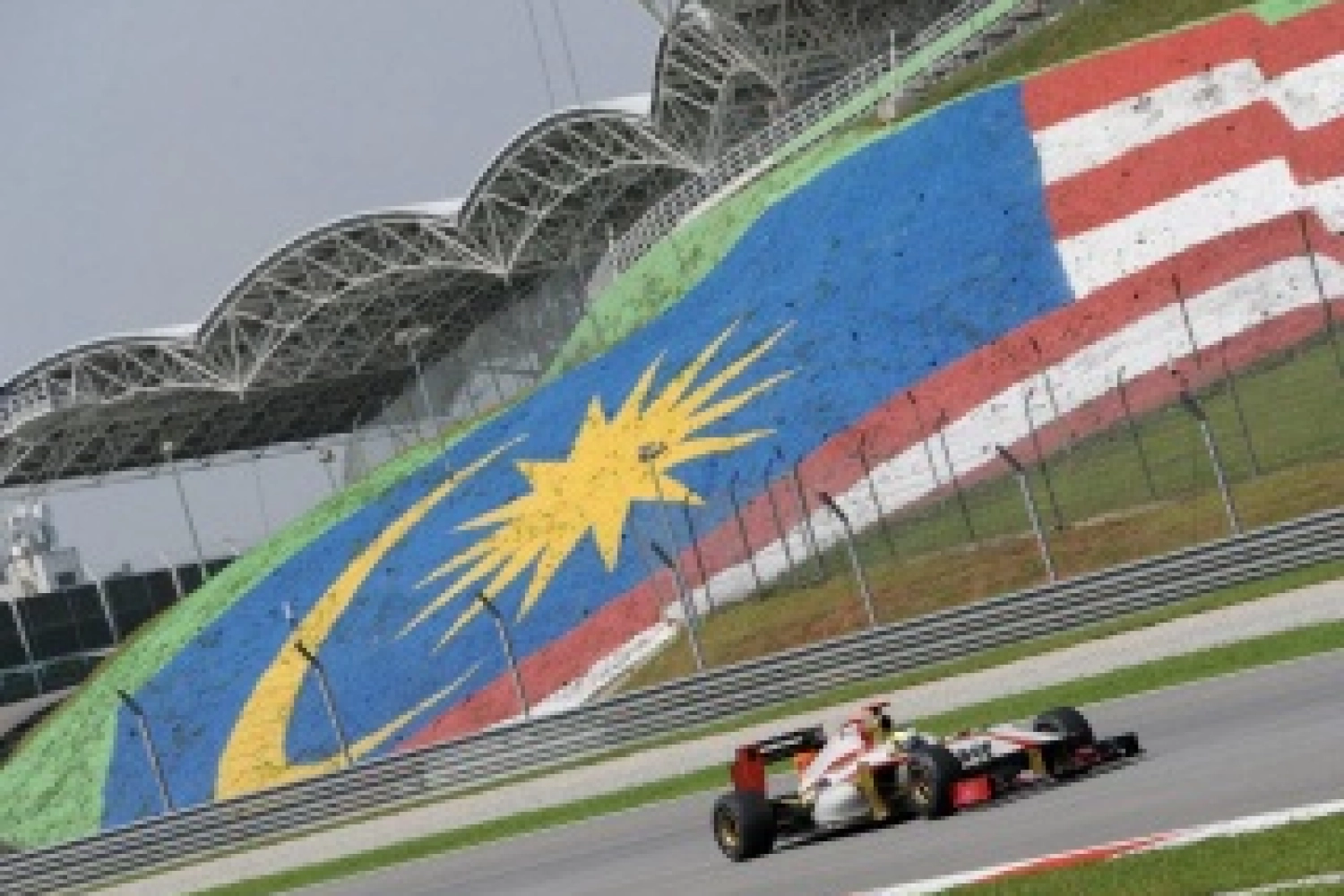
Technical, the Sepang circuit is one of the most demanding tracks for machinery and requires a mount that is efficient in all areas since it features large sections of straights as well as twisting and high-speed sectors that demand a lot of downforce. Consequently, while the level of downforce on the rear wing is almost identical to that in Melbourne, teams can load the front wing a bit less, as the risk of understeer is less significant in Sepang than in Albert Park.
The circuit designed by Herman Tilke also offers four braking zones, which are, however, preceded by long full throttle sections that leave enough time for the brakes to cool down.
On the tire front, the high temperatures, which are common near Kuala Lumpur, increase the abrasiveness of the track and therefore the wear on the tires. This justifies Pirelli’s choice to supply teams with its hardest compounds with the P Zero mediums and hards. The sequences of fast corners also place strong stress on the tires.
One of the other factors to note concerns the significant lateral loads imposed by the track; the section from turns 5 to 7 as well as curves 12 and 13 are particularly challenging from a tire perspective.
Sepang chassis side
Alan Permane, Track Operations Director at Lotus:
« The track surface is very abrasive, especially in comparison to Albert Park, which is very smooth. High-speed stability is a key requirement for tires in Malaysia due to the track layout, which includes long straights and very quick direction changes. Good traction is necessary in the first sequence, particularly to exit well from the second turn, which leads onto a long straight. To boost driver confidence, strong tire stability is imperative in the very fast curve that follows, before heavy braking into turn 4. Fast corners 4 and 5 require a stiff suspension. The car can be set lower and stiffer because there are no large curbs in Sepang. Turn 7 can be tough on tires as you enter it on the brakes. Turn 15 is a big braking zone at the end of a long straight, preceding the last turn that leads onto the start/finish straight. It provides a good overtaking opportunity, and several lines are used here. KERS is more effective in qualifying at Sepang because of the timing line position, as you benefit from KERS deployment on the launch lap. Heavy braking at the end of the straight. The brakes have cooled down on the straight and must not overheat. Good overtaking opportunity. »
Sepang engine side
The Insight of Remi Taffin, Track Operations Manager for Renault Sport F1:
« It’s generally in winter, when we test the engine on the test bench by simulating the conditions of this track, that we learn the most about Sepang. We simulate the conditions the engine would encounter on this circuit. On the test bench, we can reproduce everything the engine will face: temperature, humidity, atmospheric pressure. We subject it to these conditions to see if it reacts favorably to the characteristics of this climate. The biggest problem is the high humidity, which impacts flexibility, so adjustments need to be made accordingly. In fact, it’s quite easy because we control the temperature of the engine through the bodywork. The more cooling the engine needs, the less aerodynamic downforce you have because you need to recover air less efficiently and from less ideal areas. If you can run with a hotter engine, this leads the car to run faster because we can keep the bodywork closer to the engine. This improves aerodynamics, and teams can have maximum downforce. This is one of the strengths of Renault with the RS27: we are able to make it operate at higher temperatures without reliability issues or performance drop. This allows teams to design bolder bodyworks with a very tight rear, cola bottle style, without the usual louvers to increase the airflow towards the engine.
We will use the same engine for the Malaysian Grand Prix as the one used in Australia. It is something we already did last year. We must keep in mind that we have to manage 20 races in the season and we only have eight engines available for each car. We have developed several scenarios with the teams and agreed that we should use the engines as much as possible at the start of the season. This solution will offer us more flexibility at the end of the season.
Sepang from the tire perspective
During the entry into Turn 1, 460 meters after the start/finish line, the front tires must provide braking and maneuverability, which becomes critical mid-corner due to the low speed and therefore lack of aerodynamic downforce. Traction is particularly important in Turn 2, leading to a high-speed section; thus, a good corner exit is required.
Along the fast corners of the circuit (among which two are negotiated at speeds over 250 km/h), the tires must withstand lateral loads of up to 4G, placing heavy demands where the tire tends to heat up the most easily. A driver will need a lot of stability from the tires in turn 3 in particular.
Curves 5 and 6 are also fast. A single-seater can be set up with a low ride height and stiff suspensions due to the absence of large curbs at Sepang. As always, the tires are a vital part of the car’s suspension, absorbing bumps and imperfections on the track.
The last corner brings a deceleration of 5.3G. All the braking occurs in a straight line to maximize the effectiveness of the slowdown. The driver then steers into the corner, and the tire must absorb all the lateral and longitudinal force of the acceleration. The entry of this corner generally offers a good overtaking opportunity, also thanks to the contributions of KERS and DRS. Additionally, drivers often take different lines at this spot.
The Eye of Paul Hembery, Director of Pirelli Motorsport:
« Malaysia is one of the biggest challenges we will face this season, and it’s simply due to the nature of the track and the weather. We can expect temperatures close to 50°C and a similar gap between the two types of tires selected (medium and hard) to what we saw in Australia. Our goal remains to keep the gap under a second.
Sepang is a good circuit for overtaking and it should conform well to the characteristics of the Pirelli tires which have been specifically designed to intentionally offer a certain level of degradation. Tire strategy will be very important, particularly when it will be necessary to take care of the tires at the start of stints.
Last year, the fight for the podium lasted until the final lap and our goal, with this year’s tires, is to encourage even closer races, after an exciting start in Melbourne last weekend.
Sepang in numbers
1: The FIA has decided to establish a single DRS zone which, as in 2011, will be located on the main straight, with the detection point situated at the entrance of the final hairpin.
For the second consecutive Grand Prix, Johnny Herbert will serve as the fourth steward at Sepang.
3: This is the number of G lateral forces that Pirelli tires can withstand at Sepang, reaching temperatures of up to 130°C. The left tires do most of the work in Malaysia. The rear-left tire is particularly under pressure as it ensures the traction of the vehicle.
**3.4:** This is the highest number of G-forces endured, for 2.8 seconds at turn 5, according to Lotus.
11: This is in seconds the duration of the longest full throttle on the circuit, located on the start/finish straight.
17: This is the percentage of time spent on the brakes during a lap.
43: This is the percentage of straight line on a lap with a top speed that can reach 310km/h according to McLaren and 315km/h according to Renault.
**57:** This is the number of gear changes per lap. Turn 9 is the slowest corner, negotiated at 75 km/h, while curve number 13 is the fastest, taken at 247 km/h.
**94.223:** In 2004, Juan Pablo Montoya set the lap record at the Sepang circuit, with a time of 1:34.223, driving the BMW-powered Williams.
220: This is in km/h, the average lap speed according to McLaren, with 67% of the lap negotiated at full throttle.
500: This is in meters, the distance that separates the starting line from the first turn.
2011: In 2011, Sebastian Vettel secured the pole position at the Malaysian Grand Prix with a time of 1:34.870, at an average speed of 210.338 km/h. The fastest lap during the race was set by Mark Webber, with a time of 1:40.571 (an average speed of 198.415 km/h).
[i][Based on the respective press releases from Lotus F1 Team, Renault Sport F1, and Pirelli][/i]