Malaysia – Race: Strategy Overview
casinoenligne.uk.com invites you to discover, in graphic form, the strategies employed by each during the 2012 Malaysian Grand Prix.

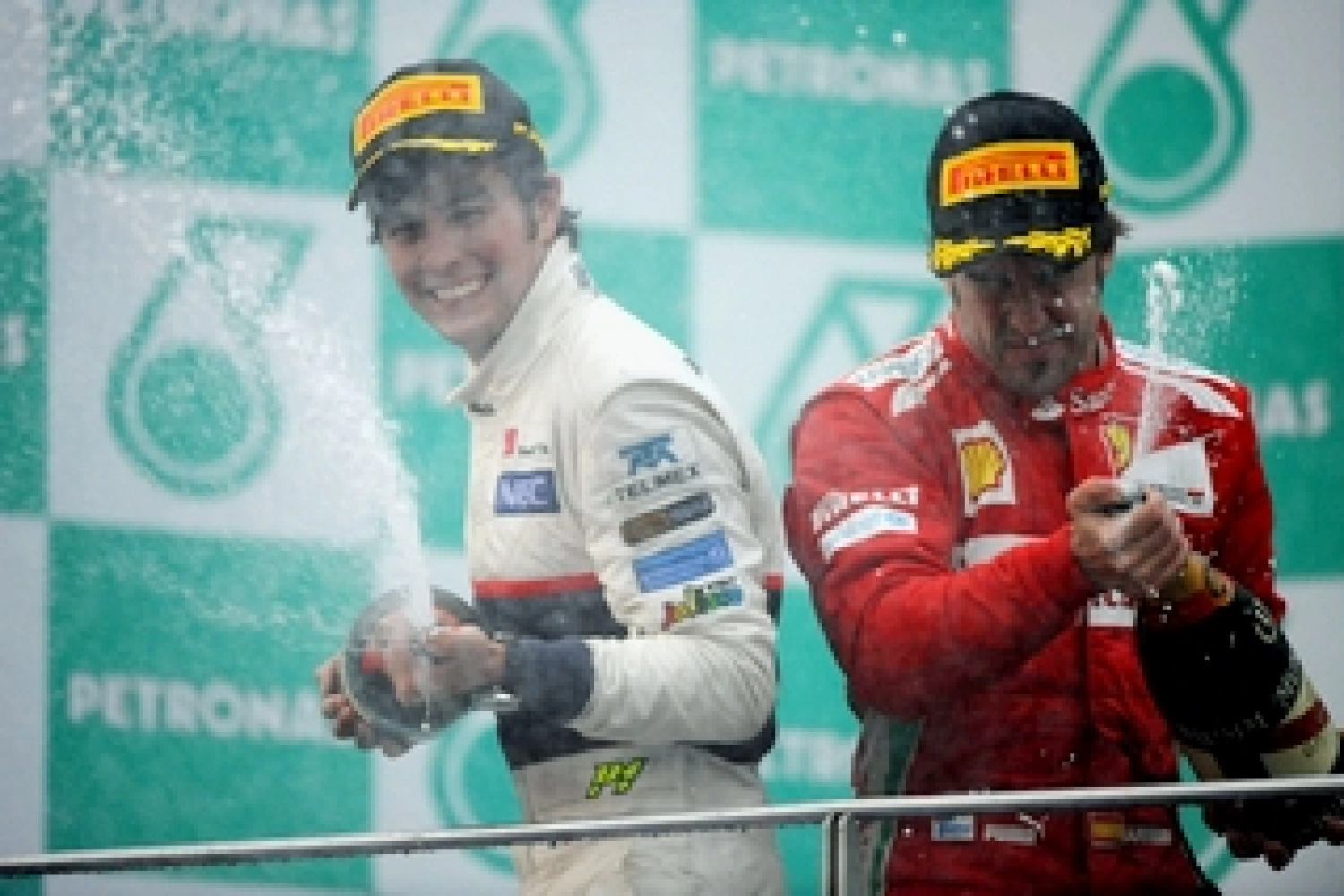
Ferrari driver Fernando Alonso used three of the four Pirelli compounds (Cinturato Blue wet, Cinturato Green intermediate, and P Zero White medium) to win a rain-affected Malaysian Grand Prix and take the lead in the Drivers’ World Championship. The tire strategy was also crucial for Sergio Perez, who secured the second-best result in Sauber’s history.
A shower before the start of the race forced all the drivers except the two HRTs to start on Cinturato Green intermediate tires. After just one lap, Perez stormed into the pits to switch to rain tires, as the rain intensified. A choice that would prove to be the foundation of his final result.
Thanks to his early pit stop, Perez managed to climb up to third place when the race was suspended due to torrential rain. The restart took place behind the safety car, forcing the drivers to resume the race on rain tires, in accordance with the regulations. As the track dried, the leaders had to switch back to intermediates, and Perez found himself in the lead for the first time before being overtaken by Alonso.
Already before being interrupted by the red flag, the race was animated by strategy. HRT decided to start the race on wet tires, propelling Narain Karthikeyan to 10th position at the time of the suspension. It was the first time the Spanish team completed a lap in the points. In contrast, Jean-Eric Vergne (Toro Rosso) remained on intermediates until the red flag, demonstrating the adaptability of the Pirelli Cinturato Greens by holding onto his seventh place, despite large amounts of water lingering on the track. Marussia also temporarily found themselves in the points, with rookie Charles Pic in eighth after the second restart.
Daniel Ricciardo (Toro Rosso) was the first to switch to slick tires on the 37th lap, fitting the medium P Zero White compound, while Alonso switched to the same medium tires three laps later, securing the 28th victory of his career.
The fastest lap of the Grand Prix was credited to the hard P Zero Silver tire, driven by Lotus driver Kimi Räikkönen three laps before the finish. The longest stint in the race lasted 27 laps, with Cinturato Green intermediate tires fitted on the McLaren of Lewis Hamilton, as well as the Sauber of Kamui Kobayashi and the Lotus of Kimi Räikkönen.
Paul Hembery, Director of Pirelli Motorsport: This race is reminiscent of last year’s in Canada, also interrupted due to rain. Once again, it generated a series of intriguing circumstances and outstanding performances, like those of Alonso and Perez at the front, who dominated the field. After the second start, it was important for the drivers to take care of the intermediates, which demonstrated great adaptability in very varied conditions, in order to keep them within their operating temperature window. The top two adopted completely different tire strategies, with Alonso choosing the medium tire and Perez running on the hard tire for his last stint, showing how our decision to reduce the gaps between the compounds leads to even closer action. Congratulations also to Bruno Senna, who achieved the best result of his career with his sixth position.
[From the official statement published by Pirelli]

Summary of Pit Stops during the 2012 Malaysian Grand Prix:
| Drivers | Teams | Stops | Fastest | Average | Total | |
| 1 | Pastor Maldonado | Williams | 4 | 21.621 | 23.635 | 1:34.539 |
| 2 | Michael Schumacher | Mercedes | 3 | 22.163 | 23.696 | 1:11.088 |
| 3 | Paul di Resta | Force India | 3 | 22.175 | 23.006 | 1:09.019 |
| 4 | Fernando Alonso | Ferrari | 3 | 22.534 | 23.350 | 1:10.051 |
| 5 | Daniel Ricciardo | Toro Rosso | 4 | 22.610 | 24.067 | 1:36.267 |
| 6 | Sebastian Vettel | Red Bull | 4 | 22.998 | 24.649 | 1:38.597 |
| 7 | Nico Rosberg | Mercedes | 4 | 23.050 | 24.270 | 1:37.080 |
| 8 | Felipe Massa | Ferrari | 4 | 23.130 | 24.630 | 1:38.518 |
| 9 | Mark Webber | Red Bull | 3 | 23.195 | 24.700 | 1:14.101 |
| 10 | Jean-Eric Vergne | Toro Rosso | 2 | 23.343 | 23.780 | 47.559 |
| 11 | Nico Hülkenberg | Force India | 3 | 23.358 | 23.588 | 1:10.763 |
| 12 | Jenson Button | McLaren | 5 | 23.477 | 26.746 | 2:13.730 |
| 13 | Kamui Kobayashi | Sauber | 3 | 23.662 | 26.013 | 1:18.039 |
| 14 | Heïkki Kovalainen | Caterham | 4 | 23.782 | 28.923 | 1:55.691 |
| 15 | Bruno Senna | Williams | 4 | 23.824 | 26.520 | 1:46.079 |
| 16 | Lewis Hamilton | McLaren | 3 | 24.271 | 26.190 | 1:18.570 |
| 17 | Sergio Pérez | Sauber | 3 | 24.520 | 24.911 | 1:14.734 |
| 18 | Vitaly Petrov | Caterham | 3 | 24.718 | 28.137 | 1:24.412 |
| 19 | Kimi Räikkönen | Lotus | 3 | 24.927 | 25.857 | 1:17.570 |
| 20 | Timo Glock | Marussia | 3 | 25.096 | 25.382 | 1:16.146 |
| 21 | Narain Karthikeyan | HRT | 2 | 27.700 | 32.288 | 1:04.576 |
| 22 | Pedro de la Rosa | HRT | 2 | 28.483 | 33.685 | 1:07.370 |
| 23 | Charles Pic | Marussia | 3 | 29.317 | 32.694 | 1:38.083 |
In order to have a better understanding of this graph, you can use the lap-by-lap summary from the FIA by clicking here.