China: Figures and Technical Data
A brief overview of the technical constraints imposed by the Shanghai circuit on the chassis, engine, and tires of Formula One cars.

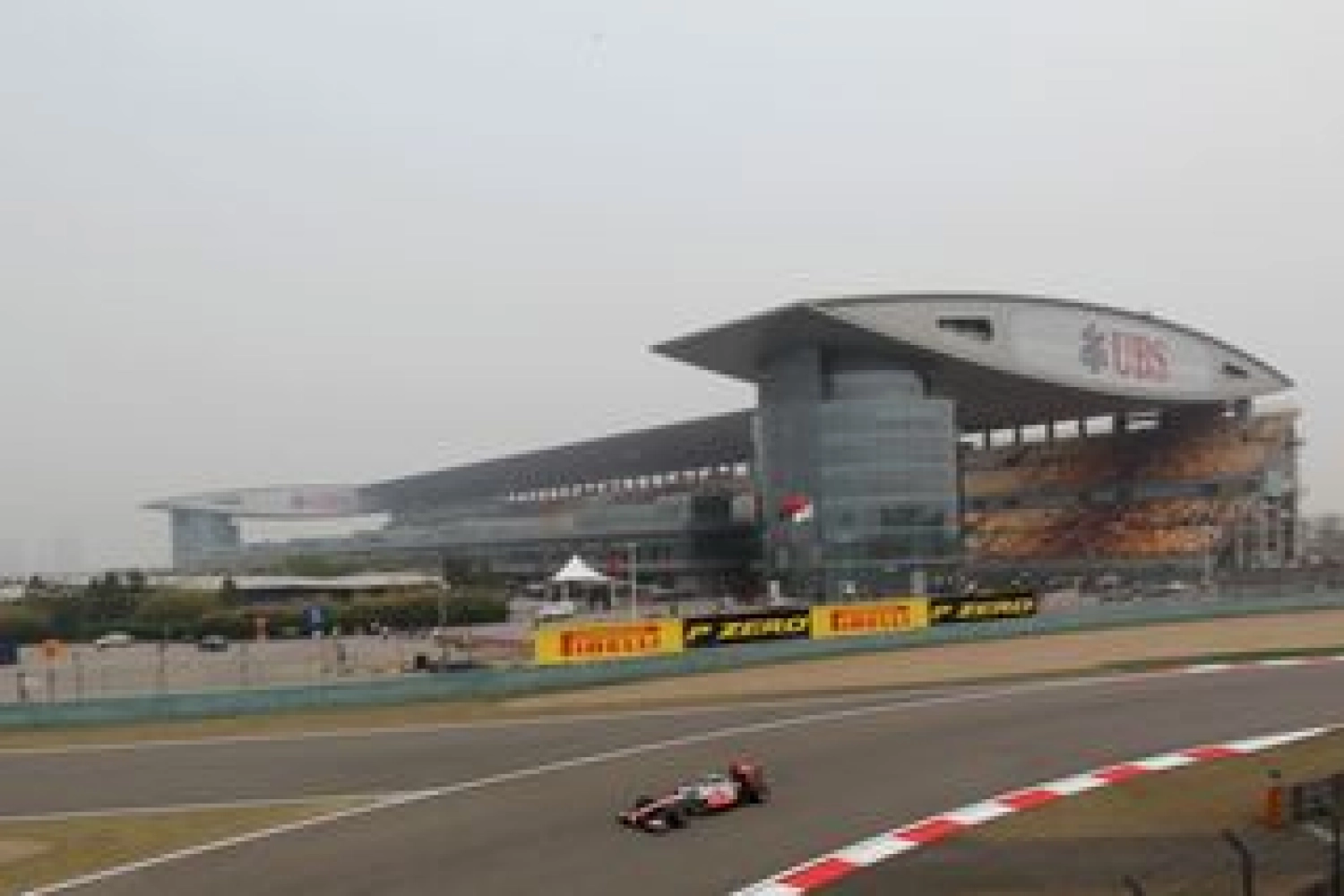
The Shanghai International Circuit was designed by German Hermann Tilke and Peter Whal. The layout is considered quite homogeneous by the drivers, with two sections standing out. The first corner, which seems endless and is not so easy to negotiate, and the long straight at the back of the circuit, the longest of the year, which should offer overtaking opportunities with the presence of DRS.
The rest of the track is a combination of low, medium, and high-speed turns. There are notably two high-speed direction changes – turns 7 and 8 – which should put the tires to the test, as they are subjected to many lateral G forces in China. Additionally, as the circuit is rarely used, the Pirelli P Zero tires are expected to degrade significantly at the beginning of the weekend due to graining.
With all these turns, the Chinese circuit demands good aerodynamics and a lot of downforce. The brakes are also put to the test, but it is not the most demanding track in this regard.
The weather could play an important role in China, as in Malaysia. Four of the last eight races have notably required the use of intermediate or wet tires. Furthermore, with the rain, the likelihood of a safety car intervention is high – it has intervened on average once per race since China joined the F1 calendar in 2004.
Shanghai chassis side
Presentation of the Lotus F1 Team
In Shanghai, slightly less downforce is required than in Sepang and Albert Park to align with the overtaking opportunities offered by the two long straights. The front wing is a bit less loaded compared to the two previous circuits.
In terms of suspension settings, the curbs are lower in height, which means that the ground clearance can be lower than usual. The bumpy braking zone at turn 1 tests the car’s damping qualities. The settings must focus on agility in direction changes required in both fast corners (turns 7 and 8) and slow corners (turns 2 and 3, then 9 and 10).
Shanghai is not a very demanding circuit for brakes. A few heavy braking zones impose up to 5 G in deceleration – turn 1 to 2, turns 6, 11, and 14 – but they are sufficiently spaced out on the lap to allow the discs and pads to cool down.
Shanghai Engine Side
Rémi Taffin, Track Operations Manager at Renault Sport F1:
«For engines, China is a unique appointment in the calendar. We have a mix of constraints with the very long back straight and the pit lane, where the engine is under extreme pressure, and two initial winding sectors that are much less severe. On most tracks, you encounter one or the other of these parameters. Monza, for example, is very fast and requires a lot of power, whereas Hungary, on the contrary, mainly demands torque.
In Shanghai, a compromise must be found. We are looking to offer a quite responsive engine to make the most of speed when entering and exiting curves, with a gearbox ratio established to maximize acceleration. The KERS will be another major asset for overtaking on the long straight before turn 14.
Shanghai on the tire side
Paul Hembery’s opinion, Director of Pirelli Motorsport:
China proved to be one of the most exciting races in our first year, with tire strategy at the forefront, which made it complicated to follow. However, the philosophy adopted this year extends the performance window of the slick tires, meaning that the drivers should be able to fight harder and closer together.
Even if temperatures can be low in China, tire degradation is often high given the unique nature of the track. So even though we will have the same compounds as in Australia – the Mediums and the Softs – our P Zeros will face a completely different challenge in Shanghai.
Shanghai in Figures
1: The FIA has decided to implement a single DRS zone, which, as in 2011, will be located on the long straight, with the detection point situated before the corner leading onto this straight. This season, however, the zone defined by the FIA will be slightly shorter – by 50 meters.
6: The number of Gs experienced by the drivers in the circuit’s most significant braking zone: turn 14 at the end of the straight, where drivers reduce speed from 320 km/h to 68 km/h in just 130 meters.
7: In 8 editions, 7 different drivers have won in China. Only Lewis Hamilton, winner in 2008 and 2011, has managed to have his name on the winners’ list twice. The other winners are Rubens Barrichello, Fernando Alonso, Michael Schumacher, Kimi Räikkönen, Sebastian Vettel, and Jenson Button.
15: The percentage of a lap of the Shanghai International Circuit spent by drivers braking.
53: The percentage of a lap of the Shanghai International Circuit spent by drivers at full throttle.
92.238: Michael Schumacher holds the record for the fastest lap, with a lap completed in 1m32.238. It was in 2004 driving a Ferrari.
1300: This is the length in meters of the straight line at the Shanghai International Circuit, the longest of the season.
[Based on statements published by the FIA, Lotus F1, McLaren, Pirelli, and Renault Sport F1]