Europe: Figures and Technical Data
Overview of the technical constraints imposed by the Valencia street circuit on the chassis, engine, and tires of Formula One cars.

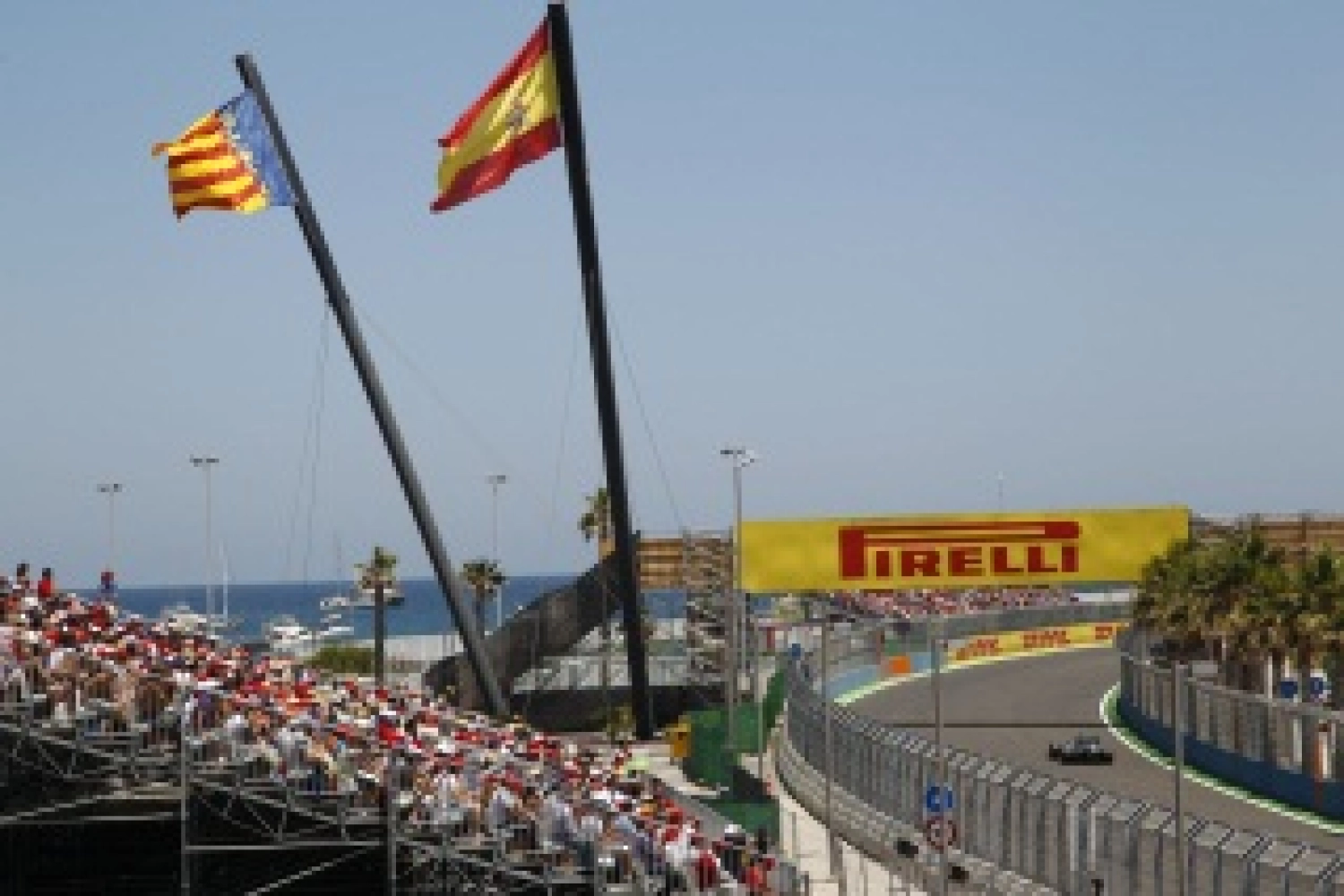
The European Grand Prix has been held in Valencia, Spain since 2008, and the circuit could be considered a peacemaker because each time, the team that won in Valencia went on to win the constructors’ title. But in a 2012 full of twists and turns, it’s hard to know if this statistic will persist.
The Valencia track is a semi-urban circuit with sections of public roads, which will cause significant tire wear at the start of the weekend. However, as the practice sessions progress, the track will rubber in and thus evolve considerably between Friday’s practice sessions and the Grand Prix on Sunday, similar to the last two events held in Monaco and Montreal.
The management of the tires will once again be an important factor for the teams in the pursuit of a good result. The qualifications will also be crucial, as urban circuits mean that overtaking is not easy to achieve in Valencia. With Pirelli bringing the Soft and Medium compounds, the most used duo of the season, the possibility of seeing one-stop strategies, as in Montreal, is far from being excluded.
These two men might be tempted to write a page in F1 history by becoming the 8th winner this year in as many races. Michael Schumacher and Kimi Räikkönen are also often mentioned as potential 8th winners this year. But history could be quite different, with a double win from one of the already victorious drivers, and why not Sebastian Vettel, who remains on two wins in Valencia.
Unusual statistic that must be noted, Timo Glock holds the lap record for the Valencia street circuit. The time set by the German driver in 2009 at the wheel of his Toyota has not been beaten in recent years. It should also be noted that Gary Connelly will be the 4th FIA steward this weekend.
The FIA has decided to implement only one DRS zone in Valencia, as was the case in Montreal two weeks ago. This zone will be located after the bridge, on the main straight of the circuit. The detection, meanwhile, will take place just before the bridge.
Valencia chassis side
Gianpaolo Dall’Ara, Technical Director of the Sauber F1 team:
« Valencia is a street circuit, but not really a typical one, because the asphalt is very smooth, and the curbs aren’t very high. Furthermore, aerodynamic efficiency is much more important here than in Monaco or Singapore, for example, and there are real run-off areas. Most of the corners are slow, but you can’t ignore the top speed. Therefore, braking stability and good traction are two important elements.
In Valencia, high temperatures are to be expected at this time of the year, so the track should be very hot. Pirelli provides us with Medium and Soft tires, which have somewhat changed since last year and this might require us to study the strategy for using them in more detail.
The degradation at the rear could be a problem. Overtaking is not easy on this track, so qualifying will be very important. The car has hardly changed since Montreal, however, we could run with more downforce.
Engine side control valve
Rémi Taffin, Head of Track Operations at Renault Sport F1:
« It’s a big challenge to define the right mapping for Valencia. The corners are quite similar: ten are taken in first, second, or third gear and therefore at fairly low speeds. Since their characteristics are close, the slightest mistake will turn into a disadvantage for the rest of the lap.
Beyond these slow corners, there are other interesting aspects to consider. The on-off nature of the track plays a crucial role in consumption, which almost reaches that of Melbourne. But since it’s generally warmer in Valencia, we consume slightly less during the race.
Despite the high temperatures, which make Valencia one of the hottest events of the year, cooling does not pose a particular problem. The long straights allow fresh air to circulate under the engine hood.
We are eager to race this Grand Prix. Making driving easier with low torque and at mid-range is one of the strengths of the Renault engine, as our engineers know how to program the mapping to deliver torque progressively. This allows the driver to control slipping and not wear out the tires too much. However, the pressure is on our shoulders to continue an ongoing streak: there has been at least one Renault-powered car in the points for the last 68 races!
Valence on the tire side
Opinion of Paul Hembery, Director of Pirelli Motorsport:
Valencia can’t present a greater contrast with the other street circuits we’ve been to previously: the circuit is faster and temperatures are higher, with a lot of energy going through the tires. What it has in common with the others is the difficulty of overtaking, which will put the emphasis on qualifying. So we expect a fairly straightforward race, with two or three stops depending on the tactics used by the teams – even though one team attempted a one-stop strategy last year.
The weather will remain consistently warm throughout the weekend, reducing weather-related variables, so there should not be any big surprises. We have used the Soft and Medium tire duo more than any other duo this year so far, as it has proven to be the perfect compromise between performance and longevity, allowing drivers to showcase their speed when necessary while also completing long stints in the race.
The opinion of Jaime Alguersuari, Pirelli test driver:
« Valencia is a circuit that I like a lot, but I’m obviously biased because it’s another home race! It’s a very challenging track due to its variety of corners and the fact that overtaking is also difficult. There’s no room for error. It’s what I would call a stop-and-start circuit, as that’s how you gain time there. Traction and braking are, of course, hard work for the tires, which is similar to Canada in this respect. Overall traction is the most important factor for a quick lap with good top speed. It’s a circuit where we usually run with low downforce, and this is another factor influencing the tires. »
Valencia in figures
1:38.683: This is the lap record, set by Timo Glock driving his Toyota in 2009.
**3:** This is the maximum number of G-forces endured by drivers on the Valencia Street Circuit.
59%: This is the proportion spent by the drivers at full throttle on a lap in Valencia.
66: This is the number of gear changes made by drivers during each lap.
316 km/h: This is the top speed that drivers will reach in Valencia according to McLaren.
2009: Valencia has hosted the European Grand Prix since 2008, and 2009 was the only year in which the winner did not start from pole position. Rubens Barrichello, driving his Brawn GP, started from 3rd on the grid. This same 2009 Grand Prix saw Romain Grosjean make his F1 debut with Renault F1.
**2010:** Stuck in the pack after a poor start, Mark Webber collided with Heikki Kovalainen’s Team Lotus. The Red Bull took off and eventually landed on the roll bar before finishing its run on what was left of its wheels and in the rows of tires.
2011: with no retirements to report during the race, the 2011 European Grand Prix becomes the one in which the most cars have finished (24) in the history of the discipline.
[From the statements published by FIA, McLaren, Pirelli, Renault Sport F1, and Sauber F1]