Hungary: Figures and Technical Data
A brief overview of the technical constraints imposed by the Hungaroring circuit on the chassis, engine, and tires of Formula One cars.

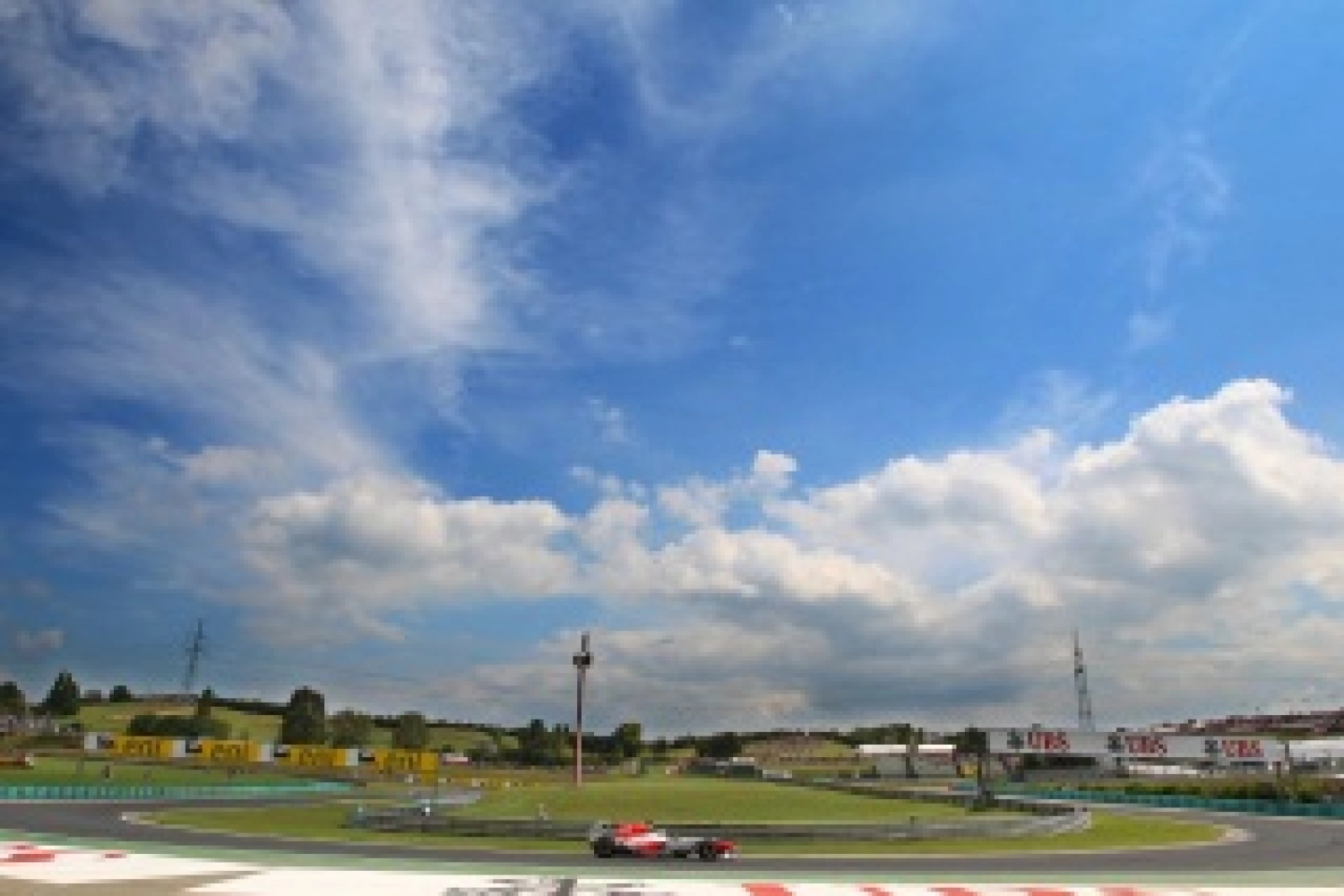
The Hungarian Grand Prix has been on the Formula 1 World Championship calendar since 1986, at the time, this event became the first F1 Grand Prix to be held behind the Iron Curtain.
The circuit is rather winding and narrow, which leads to comparisons with city circuits like Monaco, although it is a track in its own right. The single-seaters will need a lot of downforce to handle the various corners and given the few straight lines on the track. It’s a circuit where there is often only one racing line, making overtaking difficult.
Pirelli tires might struggle with the heat this weekend, as it is generally hot in Hungary at this time of year, but it can also rain, as was the case in 2006 when Jenson Button won the Grand Prix – his first F1 victory – driving his Honda. This weekend, rain is also expected: according to the latest forecasts, it could disrupt the race.
Besides Jenson Button, the Hungaroring has been the setting for firsts for several drivers, notably Fernando Alonso, who won his first F1 Grand Prix in Hungary in 2003, becoming the youngest Grand Prix winner at the time – a record later broken by Sebastian Vettel with his victory at Monza in 2008.
It was also in Hungary, in 2009, that Jaime Alguersuari became the youngest driver to take part in a Formula 1 Grand Prix, at the age of 19 years and 125 days. Heikki Kovalainen claimed his first and only F1 victory in Hungary, driving his McLaren in 2008.
Pedro de la Rosa, on his part, secured his only podium in F1 at the Hungarian track in 2006 during Jenson Button’s victory. Going further back in time, the Hungarian Grand Prix was also the site of Belgian Thierry Boutsen’s sole pole position in Formula 1 and subsequently his third and final F1 victory. This was in 1990, driving his Williams-Renault, where he managed to beat Ayrton Senna’s McLaren-Honda.
The Hungaroring from the chassis side
Giampaolo Dall’Ara, Head of Track Engineers at the Sauber F1 team:
The Hungaroring is a circuit that requires a lot of downforce, almost as much as in Monaco. This comes from the time drivers spend in corners compared to the time spent on straights. Therefore, aerodynamic downforce is the main focus. The difference with Monaco lies in the corners — which are mainly slow or taken at medium speed, but they are smooth.
It is also important to work on balance for this type of cornering. Changes of direction are also important. There are several that are taken at different speeds, from the slow chicane at turn 6 to turns 2 and 3, which are fast. An important point is also the fact that there is only one line, which makes qualifying even more important. The sides of this line are often dirty.
There may be wind at night which brings sand onto the track. So the way the tires behave can change between Friday and Sunday. Pirelli is bringing the Softs and Mediums, one level up compared to last year. With cooler temperatures, this should be a more conservative choice, but for the race weekend, heat is expected, so it should work well.
The Hungaroring from the engine side
Rémi Taffin, Track Operations Manager at Renault Sport F1:
« After one of the fastest circuits of the year, we return to one of the slowest. The winding nature of the turns and the few straight lines between them mean that maximum power is not the main objective. On the other hand, a motor capable of responding well at low revs is needed so that the driver benefits from good mechanical grip and optimal rear stability during braking. We also need to shorten the gear ratios to provide flexibility during acceleration.
The Hungaroring, with its heavy braking and acceleration phases, leads to very high fuel consumption. The initial fuel load is therefore important. This season, tire wear can have a significant influence on consumption. It is something we will closely monitor at the end of the race to prevent a driver from finishing with too little fuel or running out.
Generally, it is very hot at this time of the year, although this year, the rain seems to be closely following us! The nature of the circuit does not allow for optimal engine cooling, while the expected temperatures in Central Europe would require better efficiency in this area. Moreover, the high level of aerodynamic downforce required does not permit the addition of appendages to further cool the V8. Therefore, we are preparing for this event at our Viry factory by specifically working on the test bench to operate at low revs with high temperatures.
It’s a real challenge to approach this Grand Prix in the most technically accurate way, it’s not a calm end to the first part of the season that lies ahead!
The Hungaroring from the tire perspective
Paul Hembery’s opinion, Pirelli Motorsport director:
« The Hungaroring will offer quite a striking contrast compared to the circuits we have just visited, as it is the slowest permanent circuit on the calendar. Nevertheless, it remains a challenging place for the tires: in reality, a winding and slippery track often generates more heat on the tire than a fast and flowing track – especially in high temperatures.
That said, we had rain last year in Hungary, so it’s important not to be too assertive! We still lack information on the performance of slick tires in race conditions at the Hungaroring. Balancing the needs between speed and durability will be key to getting the most out of the tires, in order to keep degradation under control.
Overtaking is traditionally difficult, so the drivers will have a great opportunity to implement their strategy to gain positions during the race. As a result, the work done during free practice will be vital for preparing the race strategy. An opportunity that teams have not benefited from recently, due to bad weather during the last two Grand Prix.
Opinion of Jaime Alguersuari, Pirelli test driver:
Hungary is a bit like a karting track: it’s very nice but really a tough race for the tires and the driver. Your heart rate is at its highest of the entire season due to the high temperatures and the few straight lines to cool off.
In terms of settings, we run with the highest downforce levels of the season, it’s important to maximize the car’s aerodynamic potential, and this has an effect on the tires (the front left working particularly hard). With all these low and medium speed corners, combined traction and braking stability are very important. There is only one high-speed corner, which is also an overtaking opportunity.
The GP last year was really complicated: we started with intermediates before switching to slicks, but I think it should be quite different this year. The cars that should perform well this weekend are those that generate the most downforce, as this is the most important factor here.
The Hungaroring in numbers
1:19.071: This is the lap record at the Hungaroring, set by Michael Schumacher in 2004 when he was driving for Scuderia Ferrari.
3.1: This is the highest G-force that drivers must face during a lap of the Hungaroring circuit. This force is experienced for just over 2 seconds when they approach turn 11.
21: It’s the percentage of the lap during which the drivers are braking.
55: This is the percentage of the lap that drivers spend at full throttle, which is relatively low compared to other circuits in the season.
182: This is in km/h the average speed of the single-seaters on a lap, it is the lowest average speed of the season for a permanent circuit.
220: It is the maximum cornering speed, reached by drivers at turn 10.
300: This is the maximum speed reached by drivers on the Hungaroring (without DRS).
660: This is the length in meters of the longest distance taken flat out – the pit straight where drivers will be able to activate the DRS during the race.
[From the press releases published by the FIA, Lotus F1, Mercedes AMG, Pirelli, Renault Sport F1, and Sauber F1]