Singapore: Figures and Technical Data
A brief overview of the technical constraints imposed by the Marina Bay street circuit on the chassis, engine, and tires of Formula One cars.

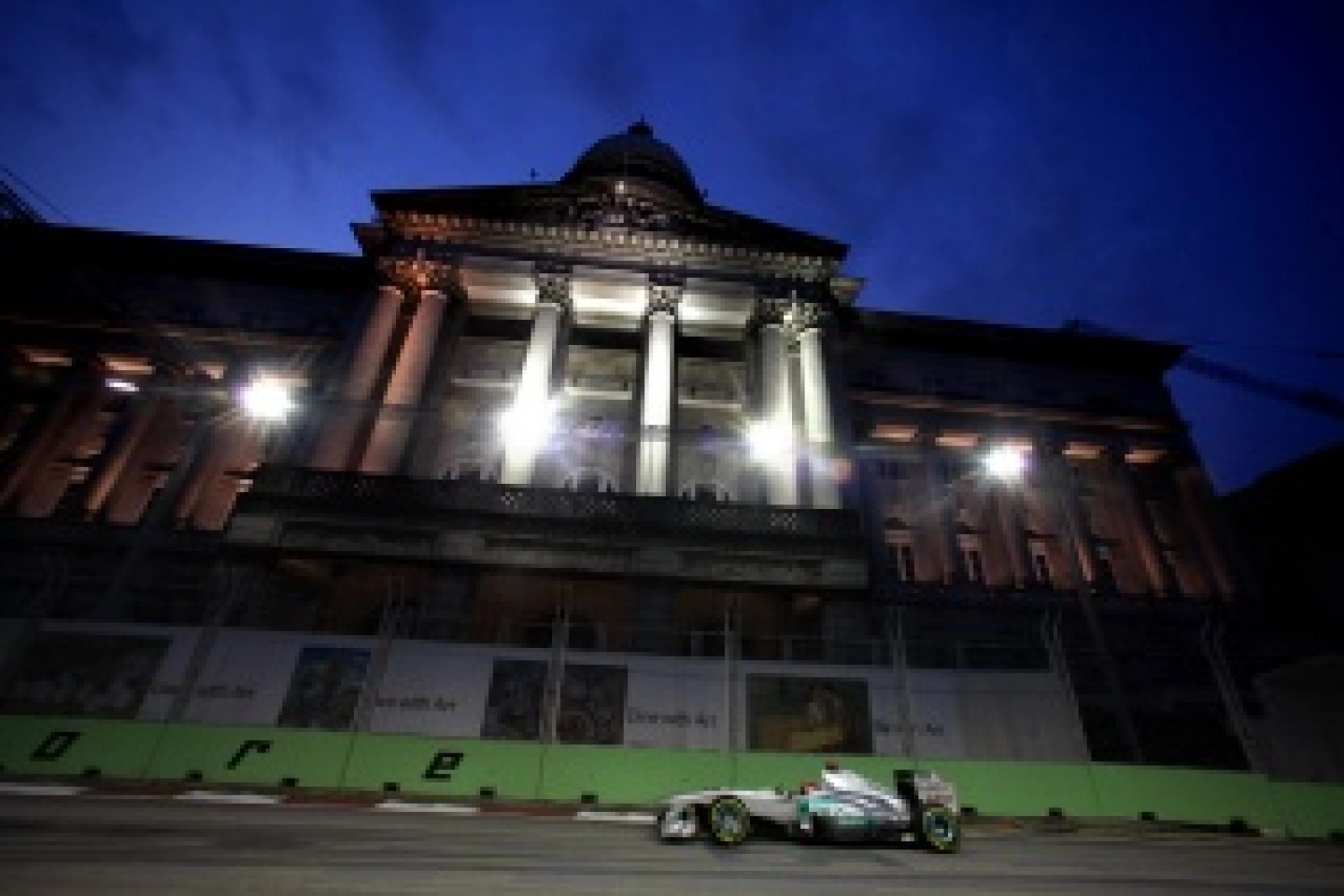
For the 14th race of the 2012 Formula 1 season, the entire Formula One Circus heads to Singapore for what is the only night Grand Prix in Formula 1. There are 1,600 floodlights to illuminate the track and ensure there are no shadowy areas on the circuit. It requires more than 3 million watts to power these floodlights, which are connected by over 108 kilometers of cables.
The Singapore circuit is an urban track and thus complicated for drivers to tackle, especially since it runs counterclockwise, which tests the neck muscles that are less commonly used.
It has 23 turns and big braking zones, making it the most challenging circuit for the brakes on F1 single-seaters. Unlike Monza, the last race held, the Marina Bay street circuit requires a lot of downforce on the car because it’s a city circuit and there are few straights.
On the tire side, with the city circuit requirement, Pirelli will offer the 12 teams its softest compounds, the super softs with red sidewalls and the softs with yellow sidewalls. As in 2011, the DRS zone will be located on the main straight of the circuit, starting after turn 5. Detection will take place at turn 4.
The strategy should be of particular importance this weekend, as while tire degradation is not expected to be too significant given the characteristics of this city circuit, qualifying will be crucial because overtaking is difficult in Singapore. Strategists will also need to react quickly in case of a safety car intervention, which has occurred at least once in the four Grand Prix held in Singapore since 2008.
Singapore from a chassis perspective
Giampaolo Dall’Ara, Head of Track Engineering at Sauber F1 Team:
« Singapore is a city circuit with many corners and short straights. Overtaking is therefore difficult, making qualifying particularly important. Good traction is crucial on this type of stop-and-go circuit with many low-speed corners and only a few medium-speed ones. In some places, the track is very bumpy – this is something to bear in mind when setting up the car. You have to keep an eye on the brakes because they have little time to cool down between corners.
The track surface is not very abrasive. Pirelli has chosen the Super Soft and Soft tires, which should work well in qualifying, but I don’t expect to see one-stop strategies during the race. As far as tactics are concerned, one thing to consider is that the likelihood of a safety car intervention is high on this circuit. This means we must constantly keep tire longevity in mind while also being ready to change our plans at any moment in case of a safety car deployment.
Singapore engine side
Rémi Taffin, Track Operations Manager at Renault Sport F1:
« After very fast circuits like Spa and Monza, we are going to Singapore, on one of the slowest tracks of the season. Only 46% of the lap is covered at full throttle, and the maximum speeds are not very high. We focus more on the linearity of the power from the lowest revs and on the engine’s responsiveness to acceleration.
Consumption is one of the highest of the year. The track is a series of accelerations and braking. At the start, the cars will be among the heaviest of the entire season. To avoid finishing with too much fuel — and thus losing time due to the weight — or with too little fuel, drivers continuously adjust engine settings to fine-tune the fuel mixture. As the power requirement is less important in this Grand Prix, we try to offer engine modes with minimal fuel injection to reduce the car’s weight at the start. Fuel acts as ballast during the initial laps.
Tire wear is also quite high because the asphalt is abrasive on these roads, which are normally open to traffic. The absence of rubber deposits on the racing line at the beginning of the weekend is another crucial factor to consider. We can reduce tire wear by adjusting the engine settings to gain rear stability and grip. With these options, we allow teams a bit more freedom to choose their strategy.
We know we have the ability to achieve good results on the streets of Singapore. The RS27 has proven to be competitive in the city and on rather slow circuits since the start of the season. We look forward to working with our partners to help them have a great race.
Singapore on the tire front
Paul Hembery’s opinion, director of Pirelli Motorsport:
« Personally, I love the Singapore Grand Prix: it is a superb nighttime spectacle, with a fantastic atmosphere and a great challenge for our tires. Due to the unusual circumstances in which the race is held under more than a thousand spotlights, teams and drivers really have to think about the strategy on a track where the conditions and evolution differ from what you might encounter during the day. A factor that can certainly come into play is the safety car.
It has been necessary at all the GPs held in Singapore so far since 2008. This means that strategies must be flexible in order to take advantage of any potential neutralization. With consistently high humidity, it hasn’t rained in Singapore during a GP yet, and it should be the same this year. We should therefore see the best performance from the softest F1 compounds in the range.
Last year, the race was won with a three-stop strategy by Sebastian Vettel, but Lewis Hamilton finished 5th having stopped 4 times and serving a drive-through penalty. The average speeds are not very high, so degradation should not be a problem if wheel spin is controlled when exiting slow corners, to avoid overheating.
Opinion of Jaime Alguersuari, Pirelli test driver:
« Singapore offers significant thermal degradation due to high temperatures, but the first thing one notices is the humidity, which is one of the factors making it such a challenging race for the drivers. The soft and supersoft tires are an excellent choice for this circuit: it’s good to return to the softer compounds after the recent races where the harder compounds were used, as they can deliver the best performances.
The feeling in Singapore is a bit like Monte-Carlo but with more fun, as there are more overtaking opportunities. I don’t think we should attempt a one-stop strategy like in Monaco, though. I believe we will see more likely two stops. The degradation rate is very low due to the little energy that goes through the tires. There are many corners, but they are all quite slow.
Singapore in Numbers
1:45.599: This is the lap record of the Marina Bay circuit, set by Kimi Räikkönen in 2008 when he was still driving for Scuderia Ferrari.
3: This is in G, the highest force drivers experience during a lap of the Singapore circuit.
5: The 2012 Singapore Grand Prix will only be the 5th edition of the night event of the Formula 1 World Championship.
9: This is in seconds the duration of the longest period spent flat out by drivers in Singapore.
295: It’s the maximum speed reached by drivers on the Marina Bay circuit according to McLaren.
400: This is the length in meters of the pit lane, one of the longest of the season.
[From the statements released by the FIA, McLaren, Pirelli, Renault Sport F1, and Sauber F1]