South Korea: The Pilots’ Perspective
Located in the countryside, the Yeongam circuit suffers from an atmosphere and a setting that still need to be developed, but it poses a unique challenge to the drivers who generally seem to appreciate the compromise it requires between a very fast first sector and two more flowing final sectors.

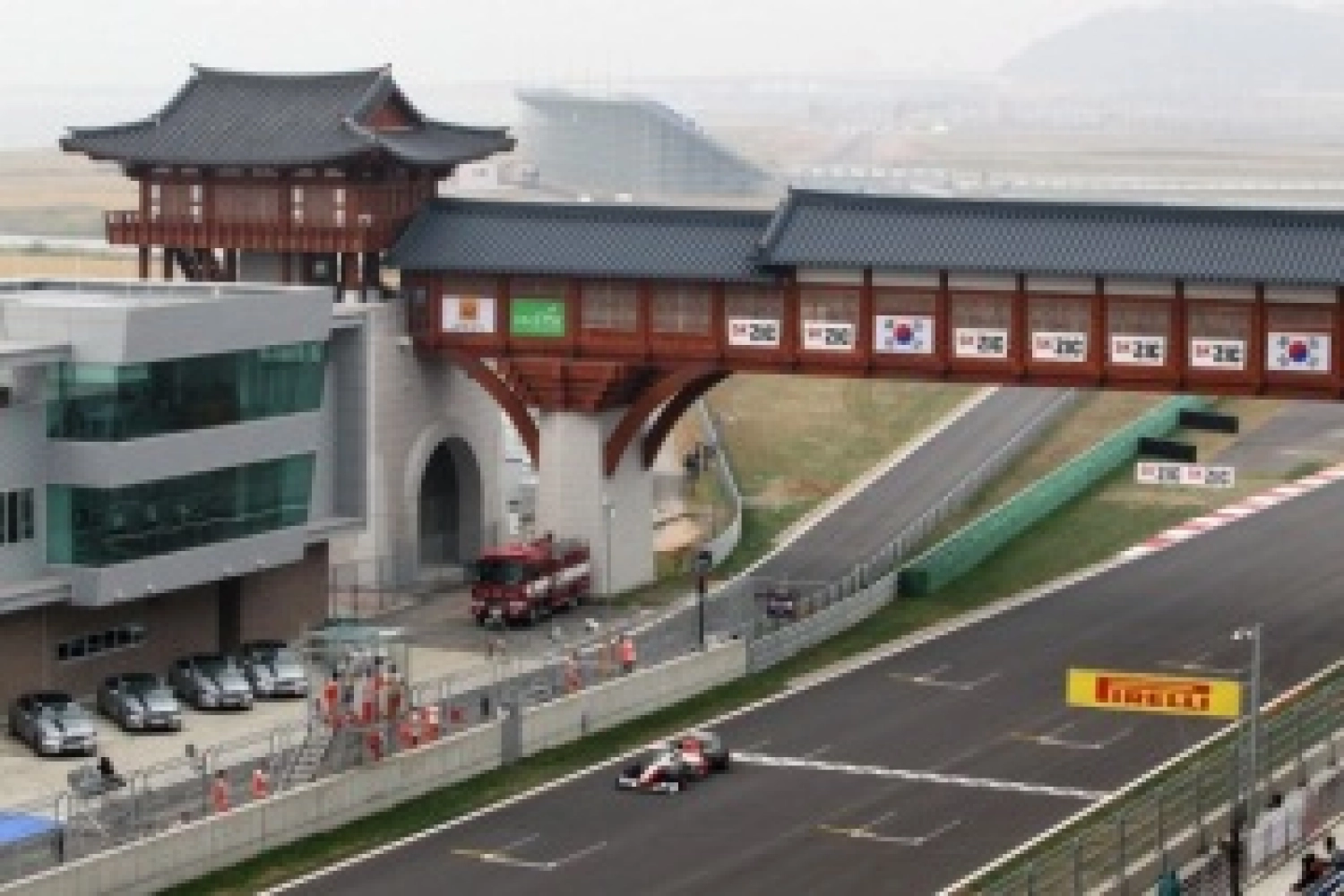
South Korea. Its fortresses, its temples, its Kombo Art Museum, its sweet potato alcohol, and… its Formula One circuit. For the third consecutive year, the grand circus of F1 makes a stop at the Yeongam circuit: « In principle, the track is composed of two parts: a permanent circuit and the end, which closely resembles an urban circuit, although there is no city around. The track is located at the western end of Yeongam province, which is very far south in the country. The circuit is demanding and the last section is very tight, » analyzes Sebastian Vettel.
Jenson Button also agrees that it is a very demanding circuit, even if it lacks fluidity: Every time you feel like you’re finding your rhythm, the track changes direction without warning. It’s not as fluid as some other recent circuits, such as the Buddh International Circuit or Istanbul Park. The first sector includes long straights: turns 1, 3, and 4 are all preceded by heavy braking and require good traction on exit. The last sector is much slower, almost reminiscent of an urban circuit, and it compromises the feeling of fluidity you’re looking for in the lap.
For his part, Nico Hülkenberg finds the circuit fun to drive: « It’s a track that’s a mix of everything: low-speed corners, high-speed corners, straights. The last sector feels like a street circuit and it’s quite technical in some corners. » Sergio Pérez has a similar view: « The Yeongam track is quite tricky. There are some very fast corners and, generally speaking, the circuit offers a great variety of corners. That said, it’s not easy to find the right rhythm, but it’s crucial for setting a good time. »
Consequently, acclimating well to the track will be vital, explains Vitaly Petrov: « The track itself is quite tricky to learn. There are some corners with blind apexes, and choosing the right gears is very important for achieving the best times, but now that we have raced there a few times, we know which direction we need to go with the settings so that we reach our goals quickly. »
However, for some, the Yeongam circuit will be a complete discovery, starting with Pedro de la Rosa: « I know very little about Korea because I’ve never raced there: everything I know comes from my work in the [McLaren, editor’s note] simulator. As it’s a track that’s barely used, the surface is very slippery. So we don’t have time to waste and we’ll have to do as many laps as possible to learn the circuit. » His teammate, Narain Karthikeyan, isn’t much better off, having only participated in the Free Practice 1 session of the 2011 edition: « From what I’ve seen, the Korea International Circuit is very complete because it mixes different elements such as walls very close to the track, fast corners, long straights, and hairpins. I’ve never raced there, so I’ll need to maximize my time on track to adapt and set up the car. »
For his part, Kimi Räikkönen indicates that he likes the feeling of driving on a new track and is not worried about not knowing the Yeongam circuit: « Since my youth, I have always been able to understand circuits very quickly. That hasn’t changed. I know some drivers work a lot on the simulator to learn a circuit, but it’s not for me. I have never played PlayStation nor spent much time in a simulator, and it hasn’t affected my performance, I believe. » On the other side of the Lotus garage, Romain Grosjean reveals he discovered the circuit on his Xbox version: « It’s not the easiest circuit to learn on a computer because the turns all look the same in their approach. I’m eager to discover the circuit at the wheel of the E20. »
The drivers will also have to contend with the weather, which disrupted the first two editions, as well as a track that is rarely used during the year. “We must expect a low level of grip, especially at the beginning, but that will change during the weekend,” explains Kamui Kobayashi. “Once the track is rubbered in, the fast sections and slower corners are fun to drive.” Meanwhile, Mark Webber points out that “it can generally be a bit cold there, so we’ll have to see what that means for the tires.” As for Vitaly Petrov, he indicates that “during the race, there is a strong chance of seeing the safety car, which was deployed during the first two races,” so the drivers and their teams must be ready to seize any opportunity that comes their way.
But this year, the Korean Grand Prix will not escape the Gangnam Style phenomenon, which is not displeasing to Nico Rosberg: « I really enjoy the circuit, and I’m excited to arrive in Korea after following the new Gangnam trend on the Internet over the past few months. When I have some time outside of the car and the meetings with the engineers, I will definitely go watch his performance this weekend. »
For his part, Romain Grosjean prefers the blend of cultures that animates the Land of the Morning Calm: « I really enjoyed Seoul when I visited it last year. It’s a fascinating mix of Asian culture and a certain European flavor. The circuit is in a somewhat remote area, and this part of Korea is very different from Seoul. This experience is certainly very different from most other Grand Prix. The circuit seems to present a nice challenge and it will be great to race in front of new F1 fans. Formula 1 is still new in Korea, so it’s fascinating to see the sport grow and meet new audiences. »
The final word goes to Michael Schumacher: « Korea is one of the most recent additions to the Formula One calendar, and this is reflected in the fact that we don’t have many fans there yet. It’s a shame because the circuit offers good races, but I think the situation improves each year. It’s a very challenging and well-designed circuit that many drivers appreciate. »