Abu Dhabi: Figures and Technical Data
Overview of the technical constraints imposed by the Yas Marina circuit on the chassis, engine, and tires of Formula 1 cars.

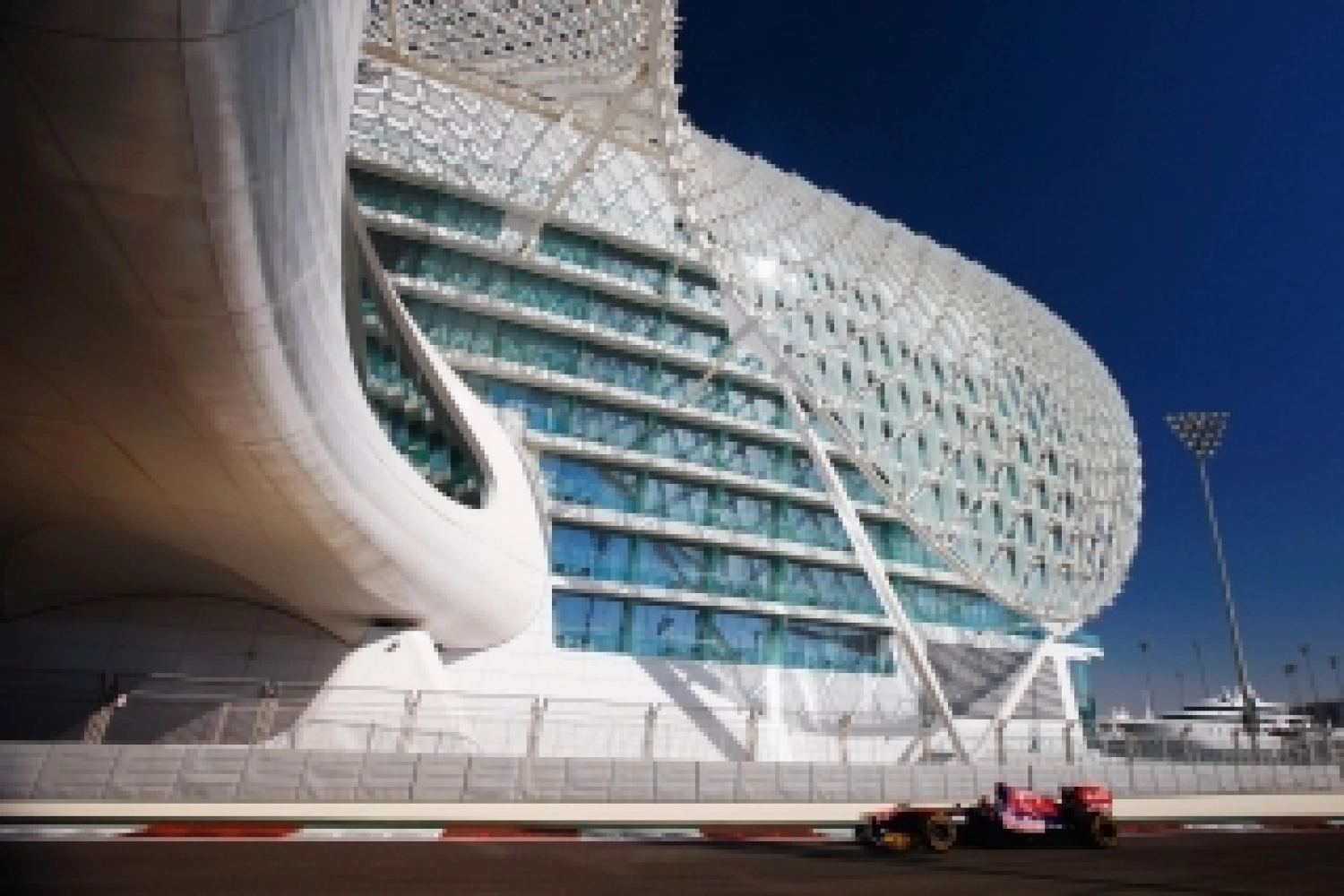
The Abu Dhabi Grand Prix has been on the F1 calendar since 2009, and the race has been nicknamed the “Twilight Grand Prix” from the start because it begins during the day and ends at night. The Yas Marina Circuit, which hosts the event, is equipped with a lighting system to illuminate the track from the start of the race so that the level of brightness remains the same, day or night.
The race closed the Formula 1 season twice, in 2009 and 2010, where the title was contested notably between Mark Webber, Fernando Alonso, and Sebastian Vettel, to the advantage of the young German. In 2011, the Abu Dhabi Grand Prix gave up its place as the closing race of the Formula 1 season to the Brazilian Grand Prix.
The Yas Marina Circuit has several unique features compared to other layouts on the Formula 1 calendar, but one stands out more than the others. It’s the pit exit, which goes through a tunnel that runs under the track, a first in Formula 1 that has not been matched to date. It is worth noting that there have never been any incidents at this spot during the first three Grand Prix held there.
On the DRS side, the FIA has decided, as in India last weekend and as in 2011, to define two DRS zones with two distinct detection points. It should be noted that the FIA has appointed Derek Warwick as the 4th commissioner for this 18th meeting of the 2012 Formula 1 season.
Yas Marina chassis side
Giampaolo Dall’Ara, Head of Track Engineering at Sauber F1 Team:
Abu Dhabi is a modern circuit, which has all the features you can expect – high speeds, low speeds, long straights, and changes of direction. Compared to the circuits of South Korea and India, it may be a bit less focused on high-speed corners. Stability under braking and good traction are crucial for achieving a good lap as low-speed performance is quite important. The tarmac is quite abrasive. Pirelli will bring the soft and medium tires, which is perhaps a bit conservative.
As in India, there will be two DRS zones with two detection zones. One of these DRS zones has been extended, which should aid overtaking. But what is most special about this event is that we will be racing at twilight. This requires us to adapt part of our work, especially during free practice 1 and 3 when it is very hot. Free practice 2 is particularly important because that’s where we experience conditions most similar to what we’ll have during qualifying and the race.
Yas Marina engine side
Rémi Taffin, Track Operations Manager at Renault Sport F1:
Yas Marina is a modern track with all the attributes of this type of circuit. There are two long straights and a variety of low or medium-speed corners with large run-off areas. The layout is quite challenging for engines, similar to Montreal or Silverstone.
The conditions and schedules make setup choices even more difficult. The reactions of the car evolve depending on the time of day. When you start at 30°C and finish at 20°C, the track’s grip changes. The engine must adapt to these new parameters.
The fuel consumption is also above average, particularly because of the nature of the final sector. This characteristic is accentuated by the low altitude of Yas Marina. We are at the same level as Melbourne in terms of the loaded weight at the start of the Grand Prix.
We are looking forward to being at the start of this race. In India, half of the top 10 single-seaters were powered by a Renault engine. As the championship is still in play, we are even more motivated.
Yas Marina tire side
Opinion of Paul Hembery, Director of Pirelli Motorsport:
« We will always hold fond memories of Abu Dhabi as it is where our F1 adventure truly began: in 2010, the teams tested our tires for the very first time during the official end-of-season tests, after the Grand Prix. It was a very special test because we were the new suppliers and the teams needed to understand our tires. We have returned to test in Abu Dhabi a few times since and launched our international media program there at the start of the 2012 season. It is the variety of the circuit that has often led us to choose Abu Dhabi for our tests. It allows us to thoroughly test every aspect of tire performance. We also appreciate this ultra-modern track and the first-rate facilities. We know that the combination of medium and soft works extremely well here.
The teams have a wealth of data on the circuit’s characteristics and should therefore be well-positioned to establish solid race strategies that will make a real difference by the end of the weekend. With the championship being so tight at the moment, having the right strategy could literally decide the title. Qualifying is also really important in Abu Dhabi, and we expect to see a big effort in qualifying on Saturday.
Lucas di Grassi’s opinion, Pirelli test driver:
Abu Dhabi is one of those races that are as much a challenge for engineers as they are for drivers. It’s all about finding the right balance: the driver doesn’t make as much of a difference as on tracks like Spa and Suzuka, for example. In terms of infrastructure, Abu Dhabi is the best circuit in the world in my opinion: it’s a fantastic place to come and see the F1s, with a little bit of everything and a spectacular setting. Tire wear is not a big issue in Abu Dhabi – good traction is the most important thing – but the work done in free practice is even more crucial than usual.
It will be vital for the teams to find a good balance on both compounds. The difference in speed between them should be quite small if the car is well set up. With the championship coming to an end, everyone will try to find that last little advantage. It will therefore be very interesting from a technical and strategic point of view. With reasonably high temperatures, tire warm-up should not be an issue, even with the hardest compound. I expect most teams to go for two stops, but some drivers might attempt only one stop.
Yas Marina in numbers
1:40.279: This is the lap record of the Yas Marina circuit, set by Sebastian Vettel driving his Red Bull in 2009.
4: This is, in G, the highest force to which drivers will be subjected on a lap of the Yas Marina circuit this weekend for the 18th round of the season.
**14.3:** In seconds, this is the longest time drivers spend at full throttle in Abu Dhabi, corresponding to 1140 meters.
31: It is, in degrees Celsius, the average ambient temperature in Abu Dhabi during the Grand Prix, which, for the record, takes place at twilight, starting in daylight and ending at night.
59: This is the percentage of the lap during which drivers can use their DRS during a qualifying lap. For comparison, the highest percentage of the season was 63% at Monza and Montreal.
60: It’s the percentage of the lap spent flat out by the drivers.
320: This is the maximum speed in km/h that Formula 1 cars are expected to reach in Abu Dhabi.
**5,389:** This is the number of LED panels on the Yas Viceroy Hotel, which spans a portion of the Yas Marina Circuit.
[From the press releases issued by the FIA, McLaren, Pirelli, Renault Sport F1, and Sauber F1]