South Korea: Figures and Technical Data
A brief overview of the technical constraints imposed by the Yeongam circuit in South Korea on the chassis, engine, and tires of Formula 1 cars.

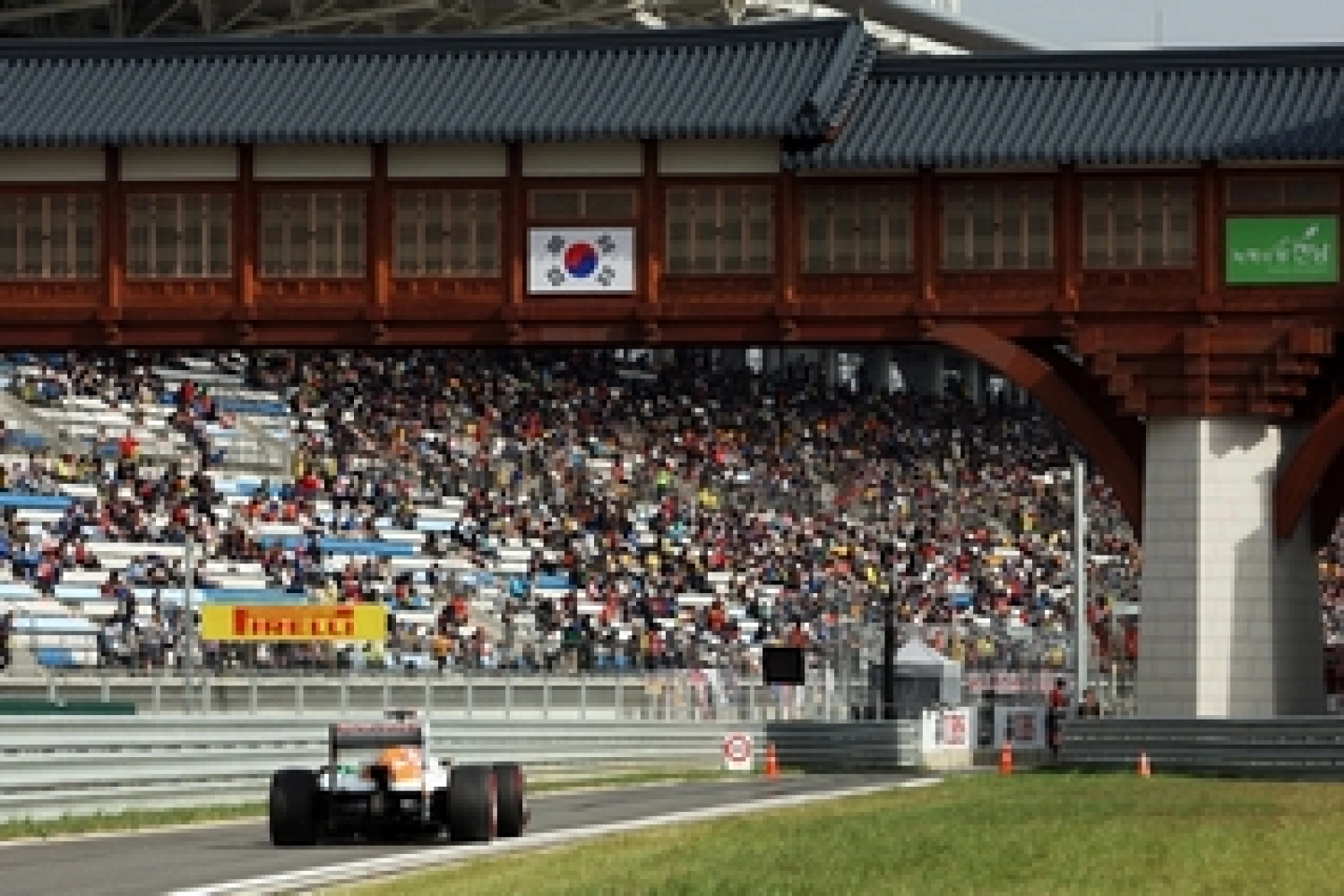
This weekend, Formula 1 heads to the Korea International Circuit for the 4th time in its history. In the first three editions, Sebastian Vettel is the man to beat on the Korean track; he won two of the three races and was on course to win the third before an engine problem forced him to retire. But in terms of teams and points, it’s Ferrari leading the way, with 85 points scored in three editions compared to Red Bull Racing’s 83.
The straight line located between turns two and three is the fourth longest of the season, with a full throttle for 15 seconds. Drivers will be able to use their DRS on this straight, as well as on the start-finish straight, with the FIA having decided to implement two DRS zones and two separate detection points. The circuit officials have decided to modify the pit exit this season.
One of the specificities of the Korean circuit is that drivers run counter-clockwise, like the tracks in Singapore, Abu Dhabi, Austin, and Sao Paulo. On the tire side, Pirelli has brought the super-softs and mediums, as in Singapore during the last race, but it will be different from last season when Pirelli had brought the super-softs and softs.
On the side of the track marshals, Emanuele Pirro – five-time winner of the 24 Hours of Le Mans – will be the driver steward. Regarding penalties, Mark Webber will receive a 10-place grid penalty after qualifying for receiving a third reprimand.
From a meteorological point of view, it should be nice on Friday and Saturday, but things could worsen on Sunday with the possible passing of Typhoon Fitow around the circuit, which could greatly disrupt the Grand Prix.
Yeongam chassis side
Tom McCullough, Head of Track Engineering at Sauber F1 Team:
The Korea International Circuit is not used much before or during the race weekend. This year, there is only one support race, which is something we rarely see. Therefore, observing and understanding the evolution of the track will be important. The three sectors of the Yeongam circuit are all very different, making it a real challenge to optimize the car. The first sector has only two slow corners; the rest is taken flat out on a straight line, requiring low downforce settings. However, in comparison, the last two sectors are a mix of slow corners, taken at medium and high speed with short straights.
As in previous years, the softest tires will be the super softs. However, as in Singapore, the hardest will be the mediums, which is a notch harder than last year. It is particularly important to understand how these tires work on a faster circuit, especially with fast corners.
Yeongam engine side
Rémi Taffin, Track Operations Director of Renault Sport F1:
The Korean Grand Prix is mid-table in terms of engine demands. There are both long straights and winding sections. The balance between power and flexibility is quite fair. It may not seem obvious, but normally the straights and corners tend to be evenly distributed throughout a lap. In Korea, it’s as if the circuit has been split in two. The first half is heavily focused on pure performance, with 80% at full throttle.
The second portion becomes very winding, with a series of accelerations and brakings. This highlights how power is delivered, engine braking, traction, and torque. There are fast corners, particularly at the beginning of the sector, but the final sequence is very ‘on/off’, with short periods of acceleration between right-angle turns. For these reasons, fuel consumption per lap is incredibly high. It’s the second highest value of the season after Spa. Naturally, we try to play with different modes to reduce the fuel load at the start of the race.
Although there isn’t much to say about Yeongam, Renault Sport F1 is eagerly awaiting this Korean Grand Prix. If one of the Renault-powered cars secures pole position, it will be a special moment for us as we will equal the record for pole positions by an engine manufacturer [208 for the Ferrari engine]. Currently, Ferrari holds the first place. Even though it’s just a statistic, it will be a special feeling to be at the top of this ranking.
Yeongam from the tire side
The tires available for drivers in South Korea are as follows:
- Super-Soft (red sidewalls) ;
- Medium (white sidewalls) ;
- Intermediate (green sidewalls) ;
- Wet (blue sidewalls).
Paul Hembery’s opinion, director of Pirelli Motorsport:
The combination proposed this year is different from last season, where we brought soft and supersoft tires; it best complements the characteristics of the 2013 tire range. We expect a significant lap time difference between the two compounds, as was the case in Singapore; this combination will allow teams to consider multiple strategies.
The Korea circuit is an interesting mix: it features fast and slower corners, but ultimately it places the highest lateral energy demand among all circuits where the super-soft tire is used; tire management will therefore be very important once again. In particular, the work done during free practice to assess the wear and degradation levels of each compound with different fuel loads will be crucial and will be the key to a successful strategy.
We saw in Singapore that having the right tire strategy made the difference. Although there is a lower probability of a safety car intervention in Korea, the teams will pay close attention to it as the championship enters its final phase.
Opinion of Jean Alesi, Pirelli ambassador:
« I have personally never raced on the Korean circuit, but I have heard many positive things about it from other drivers. It’s encouraging because when the modern generation of circuits was born, they were not very popular, but now there seems to be a different opinion, which assures that all the new tracks are worthy of the greatest drivers. What is interesting about this race is that the tire nomination is the same as in Singapore, where we witnessed a very good race.
We could see a significant difference in lap times between the two compounds, and some drivers were able to use this information to their advantage to build a good strategy. Another point we noted is the performance of the super soft tire: even though it is the softest tire in the 2013 range, it managed to complete quite long stints without any drop in performance, so I imagine we’ll see the same thing in Korea.
Yeongam in numbers
| Length of Yeongam Circuit | 5.615 km |
| Number of Turns | 18 (7 right and 11 left) |
| Average Speed | 195 km/h |
| Top Speed | 317 km/h |
| % of a Lap at Full Throttle | 55 |
| Fuel Consumption | 2.70 liters per lap; 68 l/100km |
| Lap Record | 1:39.605 (Sebastian Vettel, Red Bull Racing, 2011) |
The 2012 Korean Grand Prix
Pole position.
Mark Webber (Red Bull Racing) in 1:37.242
Podium:
1 – Sebastian Vettel (Red Bull Racing)
2 – Mark Webber (Red Bull Racing)
3 – Fernando Alonso (Ferrari)
Fastest lap in the race:
Mark Webber (Red Bull Racing) in 1:42.037
[From the press releases published by the FIA, Pirelli, Renault Sport F1, and Sauber F1]