Red Bull: Newey admits that the tire change played a role
Asked about the 2013 season, Adrian Newey discussed the difficulties faced by Red Bull, particularly the issue of Pirelli tires, whose change ended up benefiting the Austrian team.

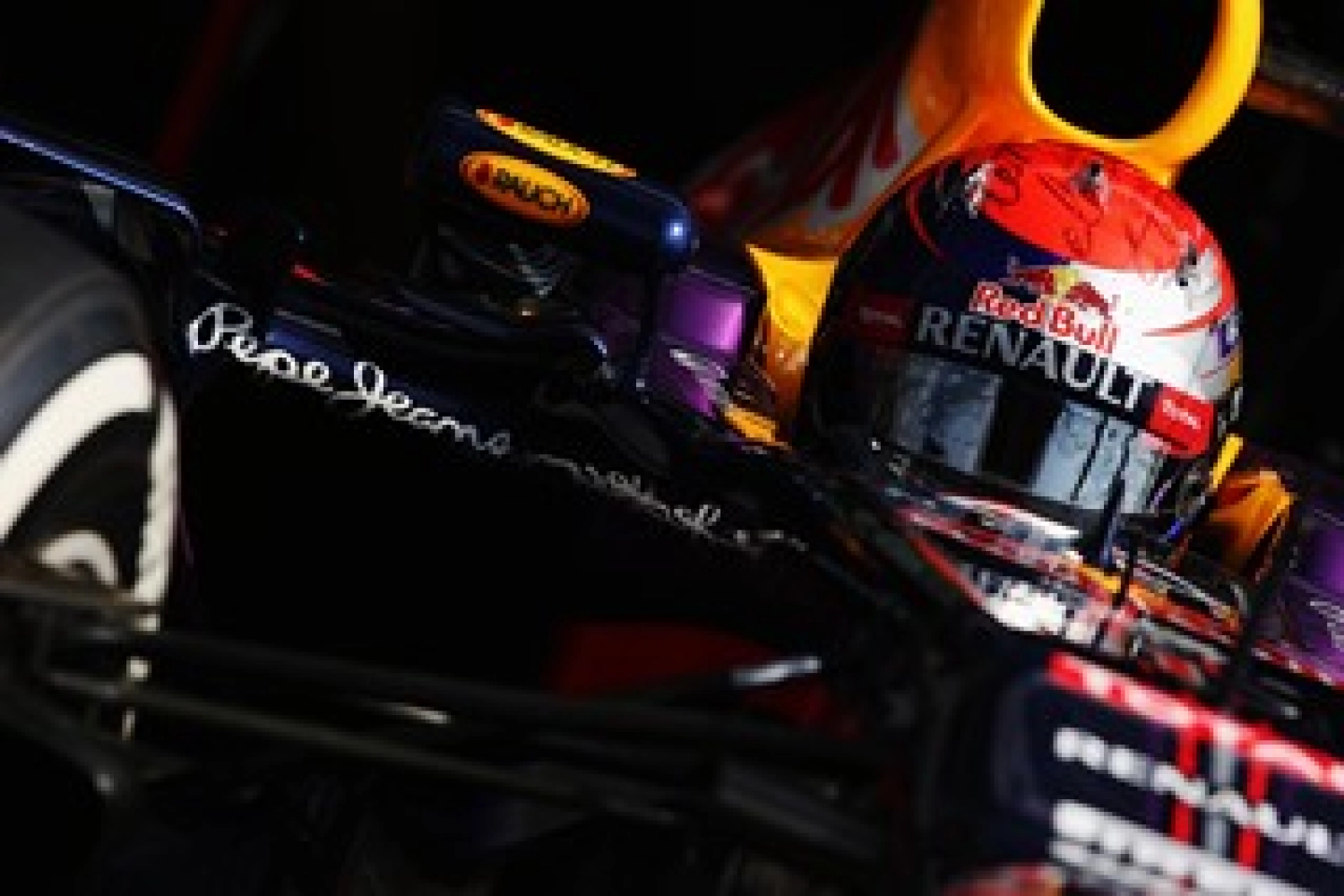
At the dawn of a 2014 season that will shake things up in terms of regulations, favoring the hybrid engine over aerodynamics and returning to a more conservative tire design, Adrian Newey, the technical director of Red Bull, the reigning four-time world champion team, reflected on the season, the last of the V8 era, marked by tire issues.
« There was no guarantee that we were going to have a good car this year, and everyone was getting closer, » he confided to Autosport. « This is the fifth season of these regulations – which are becoming increasingly strict. » The season /f1/actualite/15786-grande-bretagne-course-nico-rosberg-au-bout-du-suspense.html indeed marked the end of a regulatory period that began in 2009, during which Formula 1 cars saw the enlargement of front wings, the narrowing of rear wings, and, among other things, the end of multiple aerodynamic appendages.
The first half of the season /f1/actualite/15786-great-britain-race-nico-rosberg-to-the-end-of-thrill.html was, for Red Bull and Adrian Newey, a source of concern: « I think we saw, at the start of the season, that it was very tight. Ferrari started very strong, and Mercedes was very solid, and by the time August came, we felt it was going to be really tough. » But the work of the Milton Keynes team and the return to the tires from the previous season allowed the firm to clinch the driver and constructor titles: « And then, I think we made some improvements to the car, Pirelli also had to go back to the 2012 tires, which seemed to suit the car better, and suddenly everything went smoothly. »
The change of tires occurred after the episode of the Grand Prix of Great Britain during which four drivers experienced blowouts in the middle of the race. In a very delicate context, marked by disputes concerning the tires and their behavior, judged unpredictable, the British round had sealed the fate of the Pirelli P-Zero tires, which were replaced in the summer by those constructed according to the 2012 season standards, with these decisions being made in the name of safety.
Adrian Newey does not deny the contribution of this tire modification to Red Bull’s performances, which recorded nine consecutive victories—ongoing series—between Belgium and Brazil thanks to Sebastian Vettel: « The tire change certainly helped us, probably more than some of our competitors. »
The Briton explains this through the intrinsic characteristics of the RB9: « Our performance advantage tended to be in high-speed corners and straight-line braking, when you have maximum load on the tires. So, when you have a tire that is clearly fragile and unable to cope with significant loads […] it goes without saying that you are less able to take advantage of this. »
According to Newey, the reason for the delay in getting rid of unpredictable tires was mainly due to political reasons: « Obviously, there’s a lot of politics involved, with two teams in particular lobbying to keep the tires based on the fact that they were extraordinarily clever in designing their car around these tires. »
Such an explanation is, according to him, false, and the good management of the tires was merely due to luck: « We all played the game, but we also knew it was completely absurd because none of us knew how these tires were going to behave. We only had a very quick session in Free Practice 1 in Brazil [in 2012] with track temperatures at 50°C and that was it. Some teams got lucky and others struggled. We were in the category of those who struggled, unfortunately. »