Monaco Grand Prix 2014: Strategy Summary
After the 2014 Monaco Grand Prix, won by Nico Rosberg ahead of Lewis Hamilton, find the analysis of the tire strategy.

Monaco is a track that doesn’t use much rubber, and as an urban circuit, tire management often plays a minor role. Strategically, this limits the possibilities significantly, and deviating from a typical strategy is often synonymous with risk.
1 stop
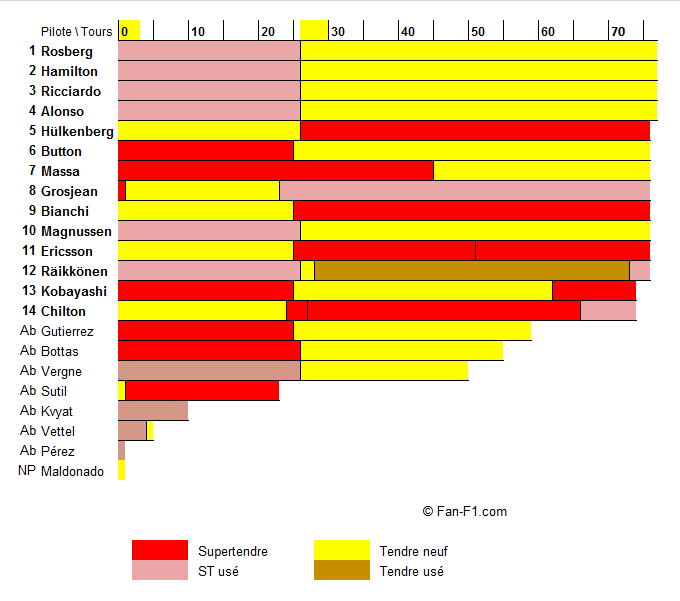
For this Monaco Grand Prix, it was written that the ideal strategy was a one-stop strategy. Nine of the ten drivers in the points at the finish used it. It’s even possible to add Romain Grosjean, who finished 8th with two pit stops that were more a matter of circumstances (collision with Adrian Sutil on the first lap) rather than a choice. In the end, the Franco-Swiss driver modeled his race after the drivers around him.
Within the drivers who executed a one-stop strategy, there are two groups: those who started on super soft tires (red) and those who started on soft tires (yellow). The first group is obviously more numerous (7 out of 9), and aside from the question of tire freshness, the first stints were of equal length (25 to 26 laps), pitting at the time of the second safety car. Only Massa acted differently by extending his stint as long as possible to gain places after his spoiled qualification, completing an initial run of 45 laps. The drivers who started on soft tires to make just one stop – Hülkenberg and Bianchi – applied similar strategies.
2 stops
Grosjean, Ericsson, and Kobayashi are the only drivers at the finish to have pitted twice. The first was thus forced to do so due to a problem in the first lap following contact with Sutil. The two Caterham drivers had mixed fortunes: while Ericsson tried an ultra-aggressive strategy, finishing the race with two sets of super soft tires, which nearly worked to get him into the top 10, Kobayashi only suffered after the collision with Bianchi.
3 stops
Finally, some drivers finished the race having made three stops: this is the case for Räikkönen and Chilton. And for good reason: the two men collided during the second neutralization, a few minutes after their respective first stops. Subsequently, the Finn had to return to the pits at the end of the race following his collision with Magnussen.
Paul Hembery, Motorsport Director for Pirelli: « Monaco is synonymous with unpredictability, and once again, we saw a lot of action, safety cars, and race incidents. Tire wear and degradation were not an issue, given the very long stints completed by some drivers, even on super-softs, and the fact that most drivers made only one pit stop. The tires on Grosjean’s car, for example, still had 20% of their rubber despite completing more than 50 laps.
Track temperatures were cooler than in qualifying, but the pace was still such that the top 4 lapped the rest of the field, with an extremely tight battle between the top three. Even though we brought a more durable tire this year, performance is overall not compromised. […] Congratulations to Marussia, who scored their well-deserved first points in Formula 1 with our tires.